

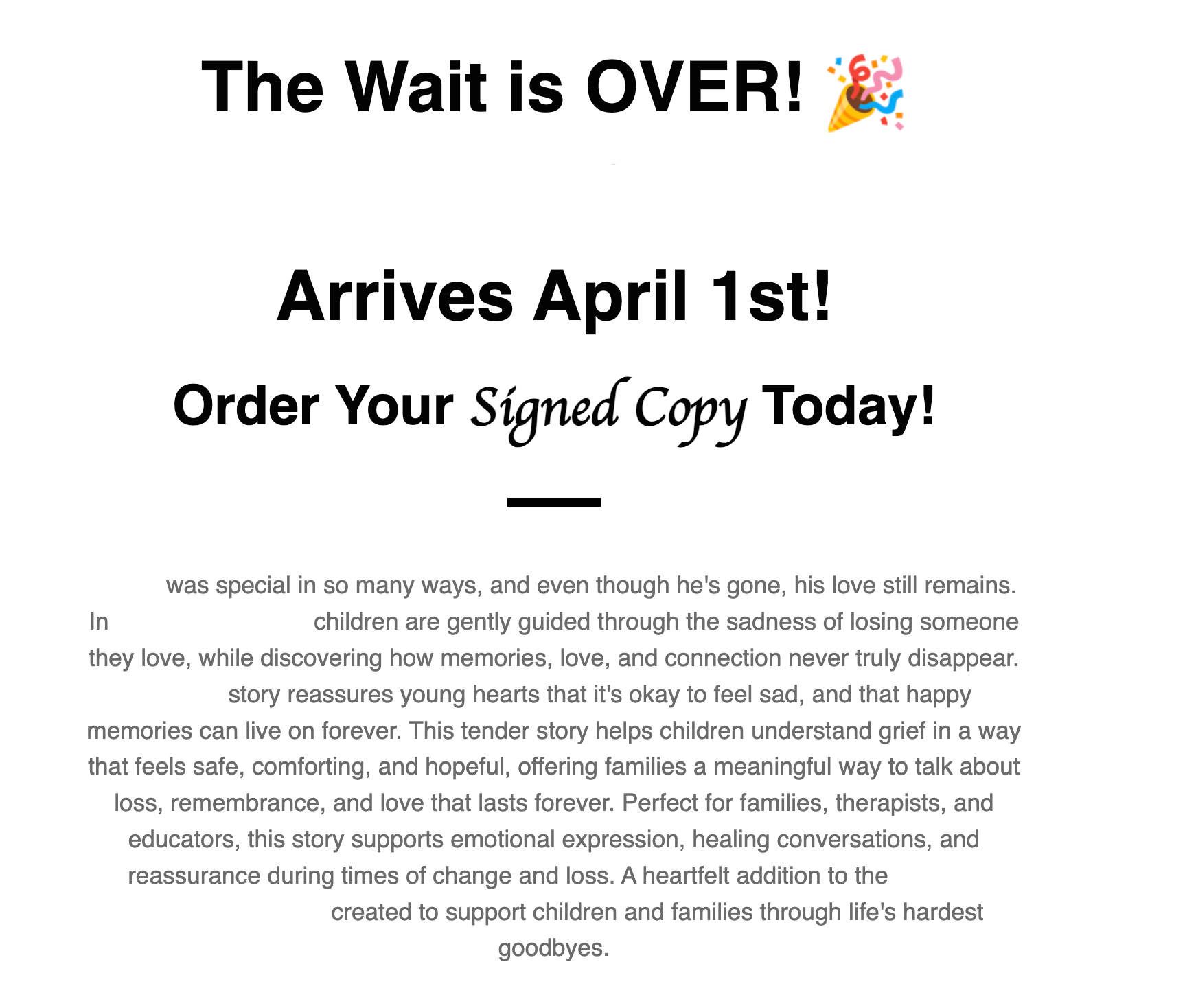
“Children are gently guided through the sadness of losing someone they love, while discovering how memories, love, and connection never truly disappear.”
That came in an email I received this week. A mass promotional mailing. Not addressed to me personally.
It’s for a children’s book. It launches April 1st.
My ex-wife wrote it.
She’s also a licensed speech-language pathologist. She helps children communicate for a living. Now she writes books about children and grief and the love that doesn’t disappear.
I sat with this for a while before I wrote anything down.
There’s a Taylor Swift lyric from 2022 that kept surfacing while I sat with it.
“Did you hear my covert narcissism / I disguise as altruism / Like some kind of congressman?”
Swift wrote it about herself. Self-examination: wondering whether generous impulses have a self-serving current underneath. She was interrogating her own motivations. She called the song a “modern portrait of a monster.”
She was talking about herself.
I’m noting it because the concept already has a name. Someone wrote it into a song.
Earlier I published a piece called “Someone Else Saw It.”
It was about a December 2011 email my wife wrote. She’d extended an open hand in July: introduced herself, praised the boys, tried to build something. By December she’d had enough.
“I see as an outsider how they are like robots,” she wrote. “Your poison has reached too far.”
That email was addressed to my ex-wife.
The person who received that letter is now writing books about how memories, love, and connection never truly disappear.
I’m not telling you what to make of that. Both documents exist. One of them arrived in people’s inboxes this week.
Researchers who study parental alienation document a consistent pattern: alienating parents typically hold a genuine belief that they are the emotionally attuned, protective parent.
Amy J.L. Baker’s 2005 research in The American Journal of Family Therapy describes this at length. The alienating parent’s self-concept is usually built around occupying the role of primary emotional caregiver. Harman, Kruk, and Hines, writing in Psychological Bulletin in 2018, describe the same: alienating behaviors and a sincere self-perception as the “good parent” coexist without apparent contradiction. Johnston and Roseby (In the Name of the Child, 1997) named it the “righteous parent” phenomenon: a deeply held narrative of moral superiority that sustains itself because it doesn’t feel like performance.
It feels like truth.
None of that is a diagnosis. It’s a description of a documented behavioral pattern. I recognize it from my own record.
I have Wendy’s December 2011 email. “Your poison has reached too far.”
I have the Facebook posts. My son describing my home as “the Demon’s lair.” His mother: “Spoken like a true wise man.”
I have the call logs. Thirty-six calls out. One in. Over two years.
My wife and I have the voicemail from a young woman who called about one of my sons in 2025. “He got me to that point where I didn’t know anymore. Please don’t give in. He’s trying to manipulate you.”
I have the four words my youngest brought home to me when he went to her with his grief after my mother died: “I have no sympathy.”
I have the hashtag she posted on my father’s obituary page and the post she wrote about finding relief in his death.
Both are documented in The Hashtag as a Knife.
And now I have this book announcement.
“Memories, love, and connection never truly disappear.”
I’ll leave that sentence right where it is.
Resources & Further Reading
Peer-reviewed research on parental alienation and alienating parent psychology informed this piece.
Parental Alienating Behaviors: An Unacknowledged Form of Family Violence Harman, J.J., Kruk, E., & Hines, D.A. Psychological Bulletin, 2018. Landmark paper classifying alienating behaviors as family violence; documents alienating parent self-perception as the “good parent.” https://doi.org/10.1037/bul0000175
The Long-Term Effects of Parental Alienation on Adult Children: A Qualitative Research Study Baker, A.J.L. American Journal of Family Therapy, 2005. Documents 40 alienation strategies and the alienating parent’s self-concept as primary emotional caregiver. https://doi.org/10.1080/01926180590962129
In the Name of the Child: A Developmental Approach to Understanding and Helping Children of Conflicted and Violent Divorce Johnston, J.R., & Roseby, V. Free Press, 1997. Documents the “righteous parent” phenomenon in high-conflict custody cases.
The Impact of Parental Alienating Behaviours on the Mental Health of Adults Alienated in Childhood Holt, S., et al. PMC, 2022. Open access. Documents personality patterns in alienating parents and long-term harm to children. https://pmc.ncbi.nlm.nih.gov/articles/PMC9026878/
Author’s Note: This article is a work of personal nonfiction based on my own memory, correspondence, and documentation. It reflects my individual perspective and experience. It is not intended as legal or psychological advice. References to published research are for informational context only and do not constitute clinical assessment of any individual.
A Note on Gender: While I write this from my perspective as a father speaking about an ex-wife, the behaviors documented in alienation research are gender-neutral. If you’re a mother experiencing this, swap the pronouns.
NEVER give up. My husband's daughters were alienated for 7 years. I prayed as I watched him slowly break down over time. He tried to overdose. There's a miraculous ending to this story that I'll also be writing about, but I want you to know there is hope. Find as much peace as you can within this terrible circumstance. Forgive yourself for mistakes, find happiness wherever you can, be strong and healthy. One day, when you least expect it, you may get an unexpected phone call or a knock on your door too...