


The chair creaks beneath you. The wood of the arms feels rough against your skin, worn down by years of sitting. Of waiting.
The room hums softly. There is the compressor of the fridge in the kitchen, kicking on and off. There is the distant, indifferent ticking of a clock. But inside the head, the noise floor is much higher.
A different kind of sound churns there: the relentless replay of the same moments, the same betrayals, the same sharp intakes of breath.
This is rumination.
In the landscape of estrangement, this is the loop that spins endlessly. It circles back on itself without ever moving the needle forward. It feels like being trapped in a room where the walls pulse closer with every thought.
The Circular Trap
The mind, when it cannot make sense of absurdity, becomes an echo chamber. It grabs onto a scene, a contradiction that defies logic, and it hits repeat.
For me, the loop often catches on the betrayal of my sister.
For years, my sister sent me emails expressing her strong disapproval of my former spouse. She saw the strain on the family. She was my witness.
But then, in 2015, the script flipped. My sister stopped talking to me. And in a twist that my logical brain still struggles to compute, she aligned herself with the very person she had previously criticized.
The two of them… once opposed… became united in their stance against me. The mind gets stuck here. It asks: How? How does a witness to the conflict become an ally to the other side? How does a narrative reverse itself so completely?
The loop spins faster. It pulls up another memory: seeing a public message my former spouse posted regarding my father right after his death, linking his passing to “#abuseawareness” and describing the loss not as a tragedy, but as a “relief.”
The pattern wasn't new. When my mother passed away years prior, my youngest son later shared how disorienting it was to bring his grief to the other household, only to be met with an indifference that felt cold and unresolved.
The mind tightens its grip. Why would someone do that? What is the logic?
This is the trap of rumination. It offers no new information. It promises that if you just play the tape one more time, you will find the clue you missed. But you never do. Because there is no logic in hatred. There is only the loop.
The Texture of Meaning
Meaning is different. Meaning does not move in circles. It moves in lines.
It is a thread pulled slowly through time. Meaning is not a sudden epiphany or a silver lining. It is simply the gradual unfolding of a new reality.
When you shift from rumination to meaning, the frequency changes. It drops.
You notice the chair again. You feel its solidity. You realize that while the betrayal is real, you are still here. The alliance of lies between a sister and a former spouse cannot touch the physical reality of your integrity.
Meaning pulls you forward, but it does not erase the ache. That is the mistake we often make; we think “healing” means the noise stops. It doesn’t. Meaning just allows the ache to exist without the frantic need to solve it.
The Sensory Anchor
When the loop is spinning fast… replaying the Cease and Desist letter you had to send, or the email where your ex-wife admitted to quitting her job to manipulate support payments… the physical world is your only anchor.
Sitting in the quiet room, you might try to just feel the coldness of the windowpane against your fingertips.
The table is hard.
The light is dim.
My hands are warm.
These are moments that refuse to be swallowed by the loop. They are facts. Unlike the shifting narratives of those who rewrite history to suit their hate, these facts do not change.
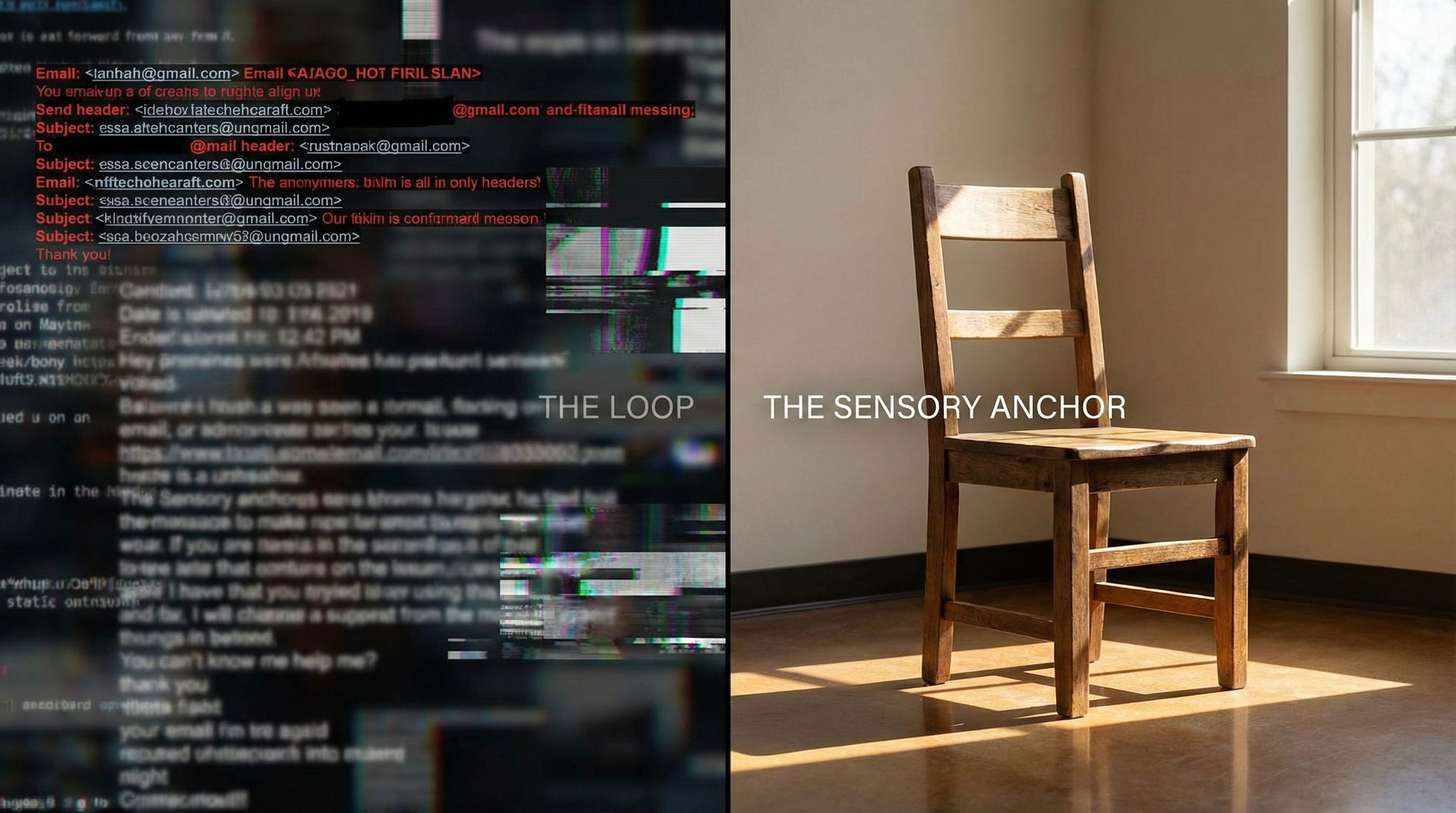
Stuck vs. Moving Through
You can feel the difference in your nervous system.
Being stuck in rumination feels crowded. It feels like clutter, like a mix that is too loud. There is tension in the shoulders, a tightness in the chest.
Moving toward meaning feels slower. Quieter. It is not necessarily “happy.” You might still feel profound sadness that your sister is gone, or that your father’s memory was disrespected. But there is space around the feeling.
You stop trying to force the loop to resolve. You just let it play out, and you turn your attention to the window.
An Unanswered Question
The mind replays what the heart cannot resolve, circling the flame like a moth. We want to understand so that we can stop hurting.
But what if the understanding never comes? What if the “why” is a door that is locked from the other side?
Perhaps the work is not to escape the loop, but to learn how to live within the turning of it. To listen to the silence that sits underneath the noise.
How long can the mind hold space for a heart that still waits, still wonders, and still aches?
Author’s Note
This article is a work of personal nonfiction based on my own memory, correspondence, and documentation. It reflects my individual perspective and experience, and is not intended as legal or psychological advice. Some names, timelines, or identifying details may have been changed to protect the privacy of all involved.
A Note on Gender: While I write this from my perspective as a father speaking about an ex-wife, the behaviors of alienation and high-conflict control are gender-neutral. If you are a mother experiencing this, simply swap the pronouns; the pain and the patterns are exactly the same.
Resources & Further Reading
The Science of the Loop
Rethinking Rumination: PubMed Study
The Worry Trap: Book by Chad LeJeune, PhD
Finding Meaning in Chaos
Man’s Search for Meaning: Viktor Frankl
Ambiguous Loss: Dr. Pauline Boss
Grounding the Nervous System
Anchored: Polyvagal Theory by Deb Dana