

Last Tuesday I was in line at the hardware store and the man ahead of me was buying paint with his son. The kid was maybe twenty-three. Tall, looked a little impatient, doing that thing where he’s helping but mostly looking at his phone. They were arguing about a finish. Eggshell or satin. Nothing.
I noticed I felt nothing sharp. That’s the thing I want to tell you about.
A few years ago that scene would have cost me the rest of the afternoon. The held breath, the replay, the slow drive home with the radio off. It felt like the floor tilting a few degrees, just enough that everything slid toward one corner. Last Tuesday I paid for my caulk and a furnace filter and I drove home and I put them away. The whole thing lasted as long as it took to ring up. Then it was just Tuesday again.
I used to think the absence of pain would feel like progress. It mostly feels like furniture.
The room with no clock
Grief has a past tense. Someone is gone, you mark it, the world hands you a script. Casseroles. A date on the calendar. Crisis has a present tense, all alarm and motion, everyone leaning in.
What I’m in has no tense at all.
My sons are alive. I know roughly where they are. Nothing is ending and nothing is being repaired. There’s no funeral for a relationship that’s only paused, and no reunion to plan for one that hasn’t resumed. You don’t get a ritual for the middle. You just get the middle.
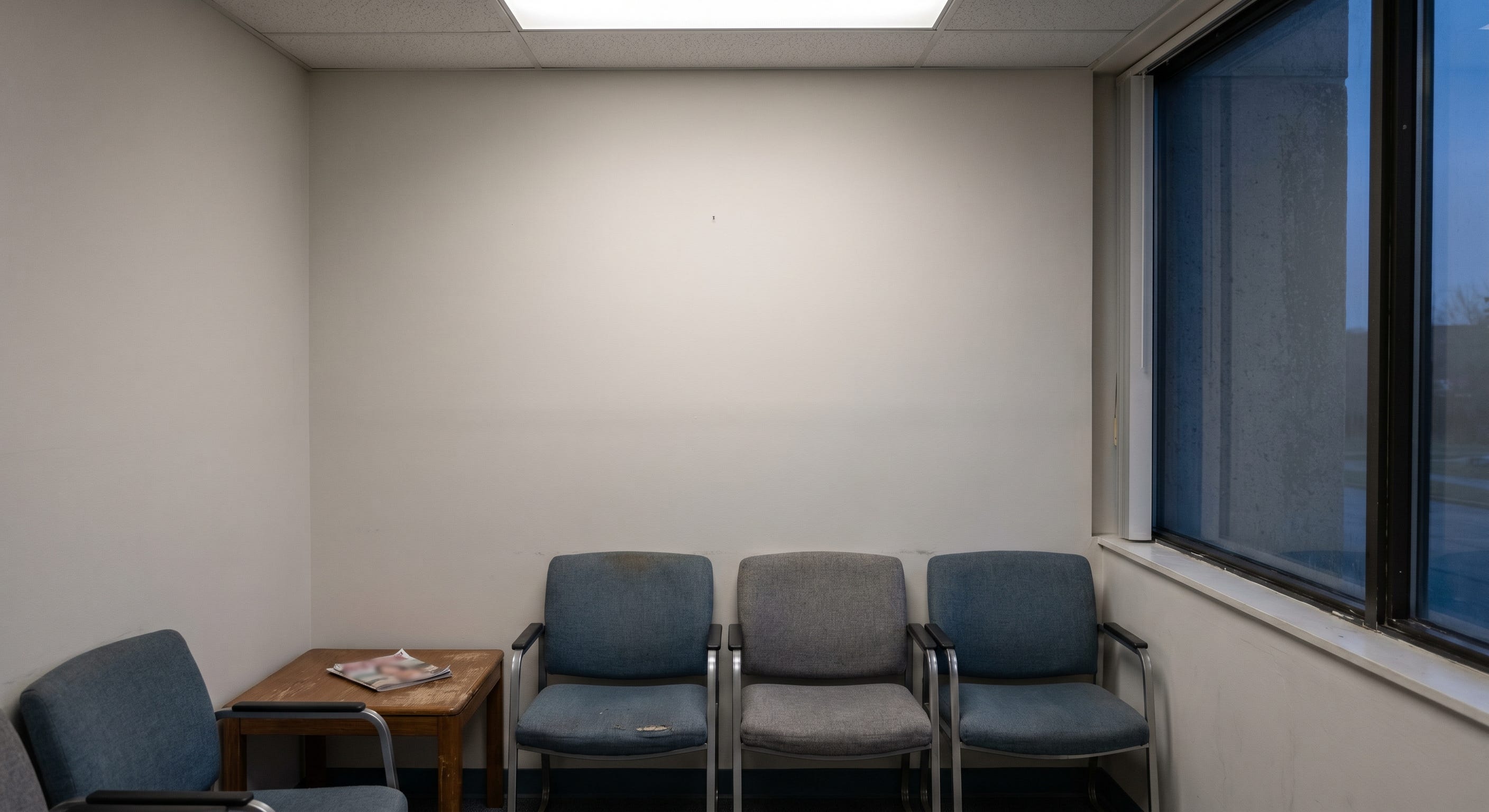
I’ve started thinking of it as a room. Not a dramatic one. A waiting room, the ordinary kind, bad chairs and a magazine you’ve already read twice. The strange part is there’s no clock on the wall and no one comes to call your name. You stop being sure what you’re waiting for, or whether “waiting” is even the right word for sitting somewhere this long.
What I actually let go of
A few days ago I wrote that I stopped waiting. I meant it. But I’ve been turning the sentence over since, because it isn’t the whole truth and I don’t want to hand you a clean version of something that isn’t clean.
I stopped waiting at the window. I did not leave the room.
The window was the active part. The watching. The math by the hour. The way a single holiday could organize a whole day around a phone that didn’t ring. That’s what let go (It didn’t feel like a decision. More like a muscle that finally stopped cramping.) What stayed is smaller and harder to name. I keep the room. I haven’t packed it up. The number’s the same, the door’s the same, and the version of me that would answer on the first ring is still in here somewhere, sitting in one of the bad chairs.
So when I say I stopped waiting, I don’t mean I left. I mean I stopped standing at the glass. There’s a difference, and the difference is most of my life now.
What people say
Someone sent me an article last month. Kind person, meant well. It was one of those pieces, and there are a lot of them lately, about how estrangement is rarely permanent. People move in and out of it. The door is never really shut. Reconciliation, they say, is more common than you’d think.
I didn’t argue. I’ve stopped arguing with the good news.
But there’s something those pieces leave out, the thing I’d want someone to actually say to me. “Rarely permanent” is its own kind of weather. It’s mostly true and it’s mostly kind and it still sets the whole sky on your shoulders, because if it’s rarely permanent then the part that isn’t moving must be, what. Something you’re doing. Something you could fix if you found the right sentence.
I live under that low pressure most days. I hold the hope loosely, because holding it tight is how it cuts you. I don’t lean on it. I don’t throw it out either. It just sits in the room with me, the way you sit with someone you love who talks a little too much.
What it costs and what it doesn’t
The long middle gets you worst on the days you’d never schedule for it. Not the holidays. I’ve got those mapped now. I see them coming, I know what they want from me and what to do by five. It’s the random Tuesday that takes you down. A kid buying paint. A song that was on in the car when they were small. The cost shows up sideways, off the calendar, and it’s gone again before you can give it a name.
What it doesn’t cost me anymore is the whole day. That’s the trade, if it even is a trade. The grief got smaller and more accurate. It stopped taking hostages.
Some weeks it barely visits. I used to read that as forgetting, as if a stretch of not-hurting were a small betrayal I was committing without noticing. It isn’t. I checked, more than once. They’re as present in the not-hurting as they were in the worst of it. The room holds them either way, and the room doesn’t keep score of how loud I am in it.
I won’t call that peace. I don’t know that it’s peace. I see it as something closer to fluency. I’ve lived in this language long enough that I’ve stopped translating it. I know the words for the room now. I just live here.
I’m still in the room. I just stopped calling it waiting.
Author’s Note
This article is a work of personal nonfiction based on my own memory and experience. It reflects my individual perspective and is not intended as legal or psychological advice. Some details may have been changed to protect the privacy of all involved.
A note on gender: while I write from my perspective as a father, the patterns of alienation and estrangement are not gender-specific. If you’re a mother in a similar situation, simply swap the pronouns; the weight of it is the same.
Hey Steve, this is really 🔥 - Quick Updates: John is still active.
You want us to fix’s something out?