

TL;DR
Researchers interviewed 39 adults who were no-contact with a sibling. Thirty-eight described family dynamics as part of what happened. Thirty-three also described problems inside the sibling relationship itself. Thirty-two described both.
The authors call that overlap “layered estrangement.” It describes these interviews, not 82% of sibling estrangements. This was a small, highly selected group already carrying a lot of estrangement elsewhere in the family.
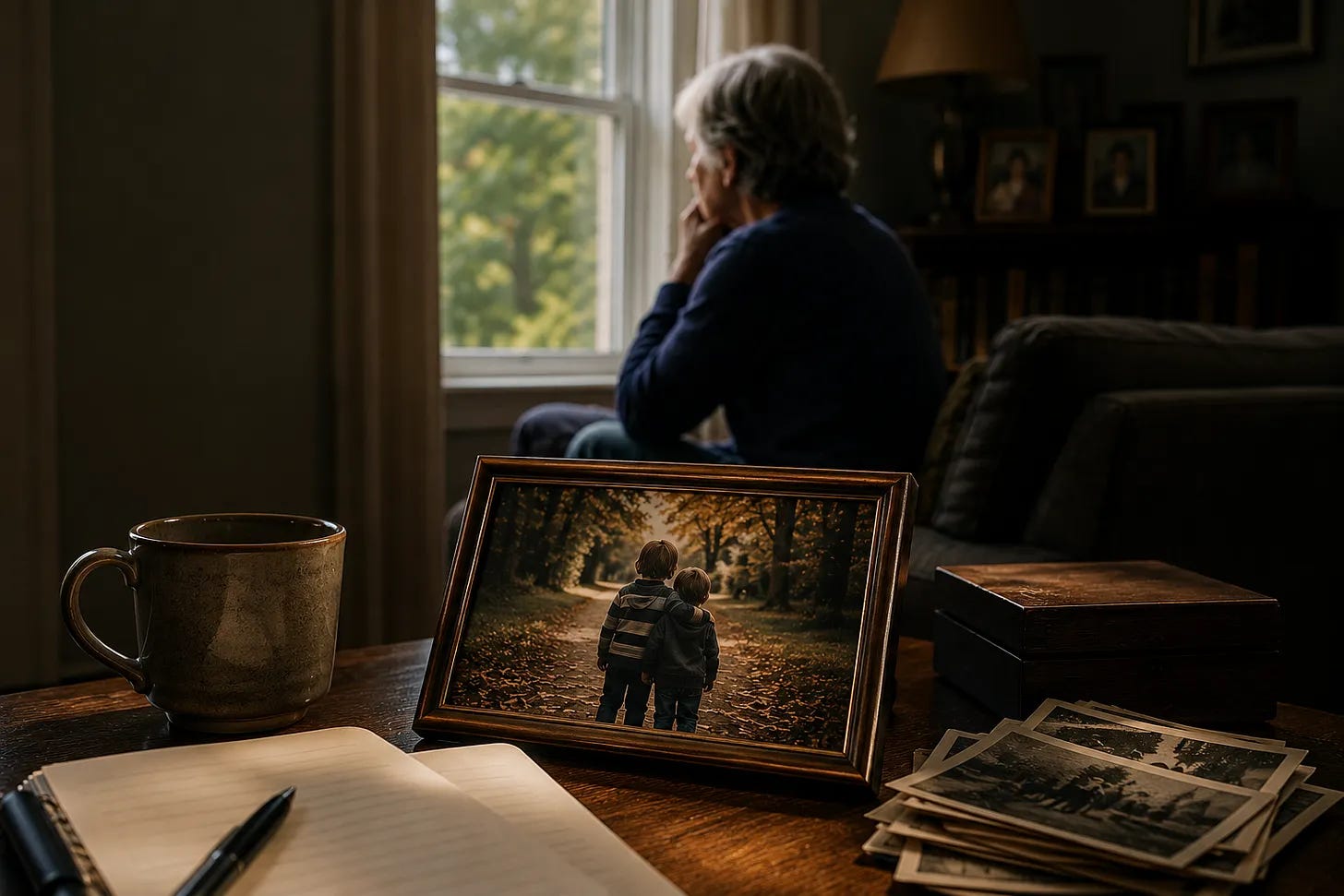
When a parent and adult child stop speaking, that can become the family story. Holidays change around it. Birthdays get strange. People learn who is still talking to whom and which subjects are better left alone.
Then sometimes the siblings stop speaking too.
I’ve written before about how estrangement doesn’t stay between two people. I still believe that. But there is another mistake sitting right beside that idea: once we see the larger family pattern, it’s easy to use it as the explanation for every relationship that breaks afterward.
I think that asks one story to carry too much.
A new study of adult sibling estrangement made me slow down there.
What the researchers actually asked
On August 18, the Journal of Marriage and Family published “Pathways to Adult Sibling Estrangement: Perspectives of Estranged U.S. Adults” by Rin Reczek, Akanne Torres Beltran and Candice Crutchfield.
The researchers interviewed 39 adults who were in no contact with at least one sibling.
They weren’t trying to figure out how common sibling estrangement is. Everyone in the sample was already living it. The question was how those people understood the path that got them there.
Two kinds of explanation showed up again and again.
Thirty-eight of the 39 talked about something happening in the larger family. Thirty-three talked about problems inside the sibling relationship itself.
The first group included what the researchers call “parental partisanship”: accounts of favoritism, unequal treatment, manipulation or scapegoating that affected the relationship between siblings. They also describe “collateral damage,” where someone became estranged from a parent and the sibling relationship later dissolved too.
I can see how quickly that second description could become the logical explanation. Parent and adult child stop speaking. Later the siblings stop speaking. The second break gets filed underneath the first.
The interviews are more complicated than that.
The sibling relationship was there too
Some participants described sibling relationships that had never been particularly close. Others talked about years of problems involving substance use, untreated mental illness or behavior they experienced as erratic. Some said they eventually ended contact because they believed continued contact threatened them, their household or their safety.
Those are the participants’ accounts. The researchers didn’t interview the siblings on the other side of these estrangements, so we don’t know how they would describe the same childhood or the same events.
I don’t think that limitation belongs in a footnote. It changes what we can say.
An interview can tell us how one person experienced a relationship. It can’t settle the relationship.
What it can show is that these participants weren’t describing their siblings only as extensions of a problem with a parent. They were talking about years spent together, whether a bond formed in childhood, what happened between them as adults and what finally made contact stop.
That history doesn’t disappear because something else broke in the family first.
Both things showed up
Thirty-two of the 39 participants described material that fit both of the researchers’ main pathways. Reczek and her colleagues call this “layered estrangement.”
The term makes sense to me because the interviews don’t require a choice between a family explanation and a sibling explanation.
In the most common version the researchers describe, something in the family had already weakened the sibling relationship. Trust hadn’t developed, loyalties had formed or another family estrangement had put pressure on the relationship. Then something between the siblings became the more immediate reason contact ended.
The order wasn’t identical for everyone and neither pathway erased the other.
That’s a messier account than saying the parent caused it or the siblings simply had their own falling out. It also sounds more plausible to me. Families have histories inside histories. People don’t arrive at an adult rupture carrying only the thing that happened last.
What 32 of 39 means
The number needs some restraint.
Thirty-two out of 39 is about 82%. It would be easy to turn that into “82% of sibling estrangements are layered.”
The study doesn’t say that.
The authors are explicit that these numbers show how often a theme appeared in their interviews. They aren’t prevalence estimates.
And this was an unusual group.
Thirty-five of the 39 participants were also estranged from their mothers and 35 were estranged from their fathers. Thirty-one were estranged from extended family. They came from a larger family-estrangement project that recruited people after news coverage about estrangement research and later through an online forum for estranged adults.
This wasn’t a random slice of American siblings.
The researchers also note that the larger project wasn’t designed to keep recruiting until they had reached saturation specifically on sibling estrangement. There may be other paths to sibling estrangement that these interviews simply didn’t capture.
I don’t see that as a reason to dismiss the study. It narrows the claim.
These interviews give us a close look at how 39 people already living with sibling estrangement made sense of it, many of them while other family relationships were broken too.
That’s useful.
It isn’t 82% of everybody.
The part I don’t want to skip
I’ve written here about the way one estrangement can move through a family. A sibling becomes a messenger. Someone gets pulled into the middle. Holidays reorganize. Relationships that weren’t originally part of the rupture start carrying some of its weight.
This paper doesn’t undo that argument. It puts a limit around it.
If two siblings stop speaking after one of them has already stopped speaking to a parent, I don’t think we get to assume we know why the siblings stopped speaking.
They had a relationship before that.
Maybe they were close. Maybe they weren’t. Things happened between them before the parent-child rupture and things happened after it. They each made adult choices. One person’s account of those years may look very different from the other’s.
The first estrangement can matter enormously without answering all of those questions.
I think that’s what I was missing when I first started looking at this study. I was interested in the family-system piece because it connected cleanly to things I’ve already written about. The more I read the paper, the less interested I became in making that connection.
The sibling relationship deserves to be examined on its own terms too.
Not because the rest of the family suddenly stops mattering. Because reducing the second relationship to whatever happened in the first one leaves part of the record unread.
That’s where I land after reading it.
The parent-child break belongs in the record. I don’t want it doing the work of evidence about everything that happened between the siblings.
Author’s Note
This article discusses published research on adult sibling estrangement. It does not claim to explain the motives, circumstances or private experiences of anyone in my family or anyone else’s. The study discussed is qualitative, based on a non-representative sample and reports participants’ accounts rather than both sides of each sibling relationship. This article is not legal, psychological or clinical advice.
Resource
Rin Reczek, Akanne Torres Beltran and Candice Crutchfield, “Pathways to Adult Sibling Estrangement: Perspectives of Estranged U.S. Adults”, Journal of Marriage and Family, first published August 18, 2026. DOI: 10.1111/jomf.70116.