

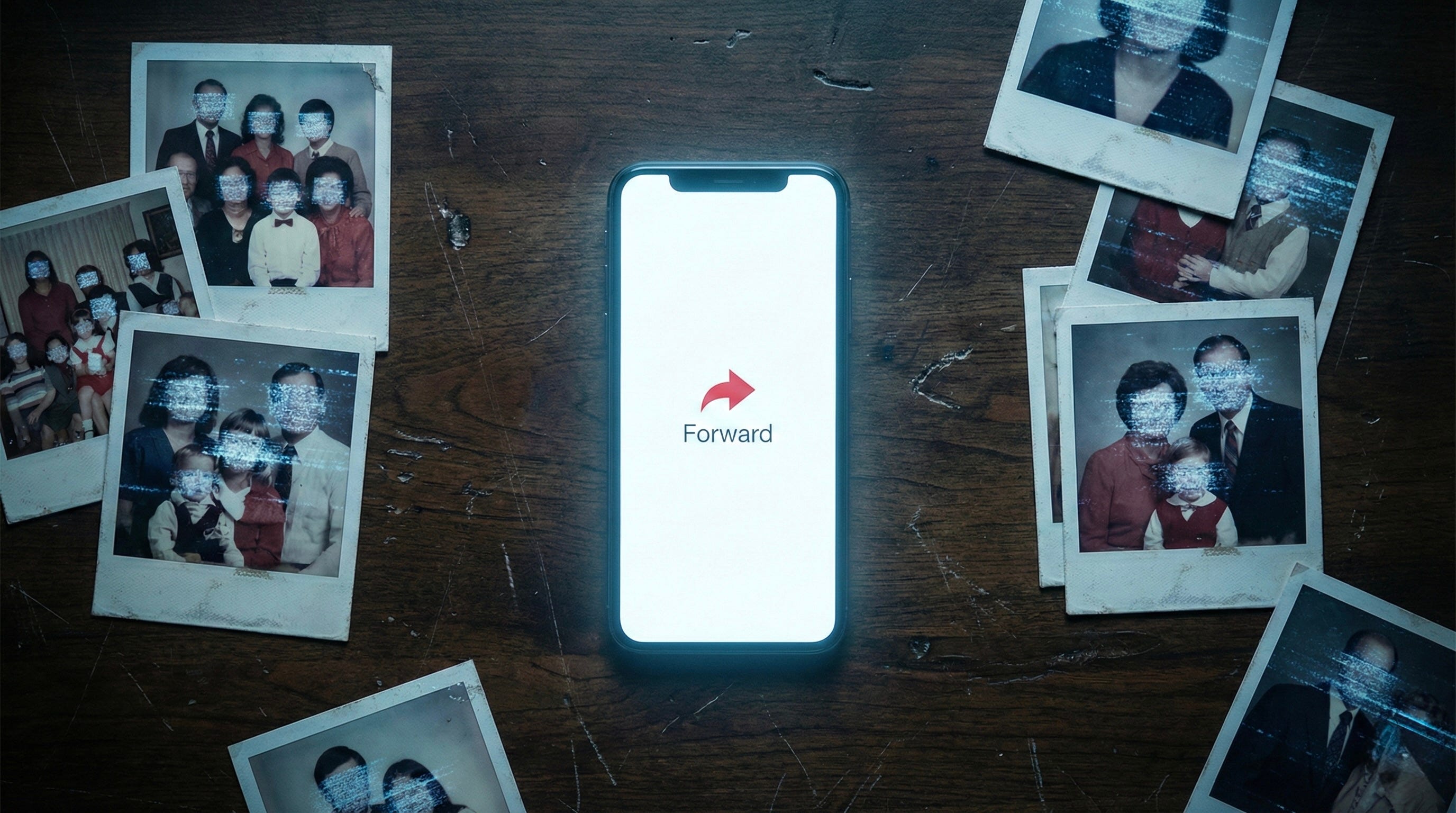
We often think of family conflict as a series of heated arguments... we imagine screaming matches in the living room or slammed doors. But in the world of high-conflict estrangement, the most devastating actions are often silent. They don’t happen face-to-face. They happen in the blind carbon copy (BCC) field. They happen with the “Forward” button.
For a long time, I lived in the confusion of the “sudden” silence. I couldn’t understand how a sibling, who had once been my witness against high-conflict behavior, suddenly appeared to become a partner in it. The math didn’t add up. Then, the evidence found its way to me. I was shown the email threads that proved while I was writing private letters pleading for peace, those same letters were being used as currency to build a coalition... in a conflict I didn’t even know was being fought.
The Architecture of Triangulation
Psychologists call it “triangulation”... bringing a third party into a conflict to validate a position and isolate the target. But that word feels too clinical for what it actually is. It is recruitment.
I remember writing an email in 2016 during a period of heavy silence. It was an attempt to be honest, to use the “I statements” I was learning in therapy to express the depth of my hurt. It was raw, and it was likely difficult for her to read, but it was intended to be a bridge. I hit send, hoping for a conversation.
The reply never came to me. Instead, the message was forwarded.
It was sent to my ex-spouse. Although our divorce decree was already finalized and the legalities were settled, we remained locked in a high-conflict cycle. Think about the impact of that specific action: my vulnerability was handed directly to the person at the center of what I experienced as a campaign to erase me from my children’s lives. In my experience, it acted as a digital signal flare: I am on this side now. Here is ammunition.
Weaponizing the “Professional” Lens
The coalition often seeks wider validation. My email was also forwarded to a mental health professional involved with that side of the family.
In the forwarded message, there was no request for advice on reconciliation. Instead, there was a layman’s diagnosis. My sibling wrote that she had counted the number of times I used the words “I,” “me,” or “my” in the letter... claiming it reached 85... and argued that this “spoke volumes” about my personality.
This is a masterclass in projection. I was attempting to speak from my own perspective... using those 85 “I” statements to claim my own pain... yet through the distorted lens of an alienated system, any expression of individual hurt is reframed as pathology. Vulnerability is twisted into evidence of narcissism. It appeared as an attempt to gain professional validation for personal disdain.
When the Recruitment Fails
But here is the validation that you, the alienated target, desperately need to hear: Sometimes, the truth is visible even through a smear campaign.
The professional maintained a clear boundary. The reply was measured and telling. She essentially questioned the benefit of sharing the email, noting that the move did not appear constructive. Even a stranger could see what the sibling seemingly could not: The problem wasn’t the letter I wrote. The problem was the choice to circulate it.
The Memories That Leave Bruises
This need to rewrite reality wasn’t a new development. In that same email thread, the sibling dismissed the physical aggression she inflicted on me as a child… the “dead arms” I remember leaving bruises on my body… as a mere joke. From my vantage point, it appeared to be how she handled her own anger or frustration. It was a behavior I didn’t see anywhere else in our home; my parents were good people who never used physical force. This was a dynamic unique to her.
It is a profound form of gaslighting. I remember clearly helping her move into her college dorm with my parents and scrawling a message on the message board hanging on her door. I wrote that I would miss her, but I wouldn’t miss the “dead arms.” I was a child trying to process pain through humor. Decades later, that childhood record… an affectionate parting sentiment from a brother who looked up to her… was used to attempt to suggest my entire life is a fabrication.

The Final Room
I saw the true depth of this animosity during a recent mediation regarding my parents’ estate. We were in separate virtual rooms; a physical barrier that didn’t stop the hostility from bleeding through the screen. The mediator, a former judge, eventually entered our room with a look of exhausted clarity. He reported that the tone in the other room had become increasingly volatile.
He described his impression of the atmosphere there as being focused on extraction rather than resolution. In a high-conflict system, “extraction” is the goal: it’s the attempt to strip a target of their resources, their reputation, and their peace of mind, without any regard for fairness or family bonds. The mediator noted that he had to intervene and set strict boundaries just to maintain the order required to continue the session.
That is the energy behind the “Forward” button. It isn’t about truth. It isn’t about “gossip.” It is a tool of extraction... a way to harvest your private thoughts to fuel a public campaign.
If you are currently confused by how quickly family members have turned against you, look for the paper trail. High-conflict people cannot sustain their narrative in a vacuum; they need a chorus. They forward your emails and share your private moments to build a consensus of blame.
When the evidence was provided to me and I saw that email chain, the confusion vanished. I realized I wasn’t dealing with a misunderstanding or a sister who was simply misinformed. I was dealing with a campaign of exclusion. And you cannot make peace with someone who is busy recruiting allies for your destruction.
Author’s Note This article is a work of personal nonfiction based on my own memory, correspondence, and documentation. It reflects my individual perspective and experience, and is not intended as legal or psychological advice. Some names, timelines, or identifying details may have been changed to protect the privacy of all involved.
A Note on Gender: While I write this from my perspective as a father speaking about an ex-wife, the behaviors of alienation and high-conflict control are gender-neutral. If you are a mother experiencing this, simply swap the pronouns; the pain and the patterns are exactly the same.
Resources & Further Reading
Foundational Concepts
Triangles and Triangulation — The Bowen Center for the Study of the Family
Why it’s relevant: This provides the clinical definition of the “Architecture of Triangulation” discussed in the article, explaining how three-person systems stabilize tension at the expense of one person.
Unmasking Therapy-Speak — PubMed Central (NIH)
Why it’s relevant: An academic exploration of how clinical language, like the diagnosis of “narcissism” mentioned in the article, is weaponized to exert power and epistemic authority over others.
The Narcissist’s Smear Campaign — Psychology Today
Why it’s relevant: Contextualizes the “campaign of exclusion” by explaining the logic behind why high-conflict individuals recruit “allies” to validate their personal script and protect their public image.
Practical Guides & Application
BIFF: Quick Responses to High-Conflict People — High Conflict Institute
Why it’s relevant: Offers a practical framework (Brief, Informative, Friendly, and Firm) for handling the “Forward” button warfare and high-conflict digital communication described in the article.
Coping With a Smear Campaign Post-Estrangement — Psychology Today
Why it’s relevant: Provides actionable advice for targets of family recruitment, focusing on accepting the loss of “allies” and maintaining personal integrity in the face of distorted family narratives.
Therapy-Speak: A Tool for Emotional Manipulation? — AMS Sexual Assault Support Centre
Why it’s relevant: A practical breakdown of how terms like “boundaries” and “narcissism” are twisted to flip the script, turning the victim into the abuser, a direct parallel to the article’s “Weaponizing the Professional Lens” section.
Deep Dives & Research
Parental Alienation and the Bystander Effect — Psychology Today
Why it’s relevant: Explores why family members and professionals often “don’t take the bait” or, conversely, remain silent, expanding on the article’s section “When the Recruitment Fails.”
Same Family, Divergent Realities: How Triangulation Preserves Illusory Harmony — PubMed Central (NIH)
Why it’s relevant: A research-level study on how triangulation creates “divergent realities” within the same family, supporting the article’s point about the “need to rewrite reality.”
Recommended Book
Why Does He Do That? Inside the Minds of Angry and Controlling Men — Lundy Bancroft
Why it’s relevant: While the article notes the gender-neutral nature of these patterns, Bancroft’s foundational work on how abusers undermine the other parent’s authority and “sow divisions” remains the gold standard for understanding high-conflict family destruction.
Video
High Conflict People and Smear Campaigns
This video features Bill Eddy, co-founder of the High Conflict Institute, discussing how high-conflict personalities use persuasive blaming and smear campaigns to recruit “negative advocates,” directly supporting your article’s themes of triangulation and recruitment.