

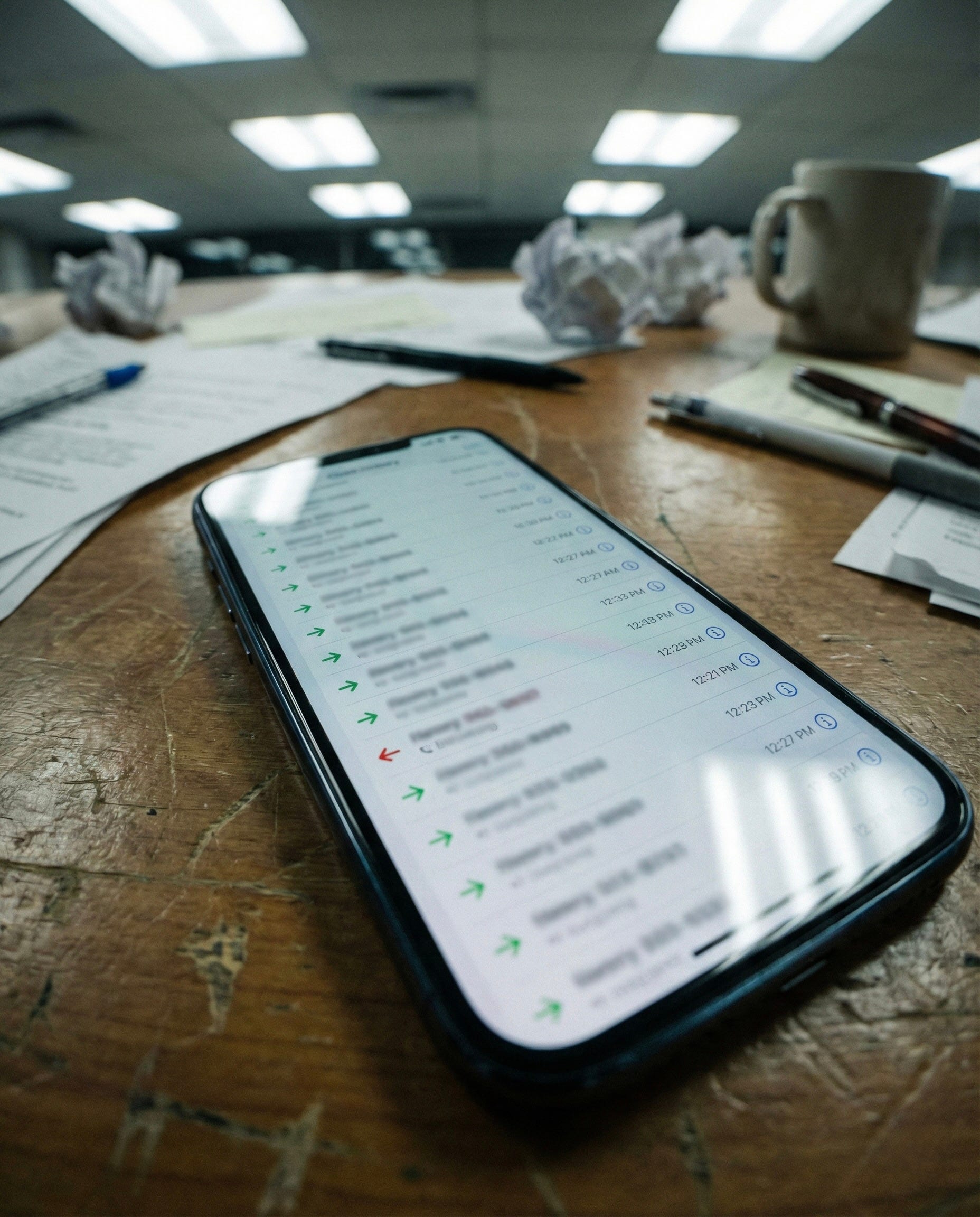
Thirty-six calls. One answered.
That is the ratio. February and March 2011: I made thirty-six phone calls to my sons. They called me once.
I did not keep that record to prove a point. The phone company keeps the record.
Now I have them. Thirty-six outgoing calls. One incoming. The timestamps do not lie.
The spreadsheet
I used to think my memory was the problem. Maybe I was exaggerating. Maybe I was not calling as often as I remembered. Maybe the silence was something I invented because I was hurt.
So I counted.
I pulled up the call logs. I counted each one.
Type Count Outgoing (me to boys) 36 Incoming (boys to me) 1
To me, that is not a relationship. That is a wall.
The emails
The calls tell part of the story. The emails tell the rest.
Between July 2011 and March 2013, I sent ten documented email requests to my ex-wife asking her to have our sons call me. Ten. Over nearly two years.
July 2011: “Can you please make an effort to have the boys call me.”
That was the first one. I was polite. I assumed it was an oversight.
August 2011. November 2011. December 2011. January 2012. February 2012. March 2012. July 2012. March 2013.
Ten requests. Same request. “Please have the boys call me.”
In one of those emails, I asked: “Is a parentectomy your goal?” The word means what it sounds like: surgical removal of a parent from a child’s life.
I meant it as a question. Looking back, it felt like a diagnosis.
The categories
By 2015, I had organized the non-responses into categories. Not because I wanted to. Because I had to.
Nine categories. Nine types of communication that went unanswered.
Travel: I sent requests for international travel months in advance. Certified mail. UPS tracking. Documentation that I had given proper notice.
School: I had to independently contact the school to learn my sons’ AP History assignments. Their ACT scores. Information that should flow freely between parents.
Phone calls: A document titled “Boys aren’t answering or returning phone calls.pdf.” That was its name. That was the problem reduced to a filename.
Personal items: I sent family photos to my sons via UPS. With tracking. With signature confirmation. Because informal communication was not working.
Milestones: Eighth grade graduation trip. Prom. Events that required formal written requests because asking did not produce answers.
Last-minute cancellations: Events I had planned for, cancelled at the last moment.
I had to use certified mail to send my own children photographs. I had to use tracking numbers to prove I had tried.
When you have to document the act of reaching out because reaching out is not enough, something has broken.
What the numbers say
I am not asking you to believe a narrative. I am asking you to look at numbers.
Thirty-six calls out. One call in.
Ten email requests over two years. The same request: “Have the boys call me.”
Nine categories of non-response, each with its own folder, its own paper trail, its own proof of delivery.
The numbers do not require interpretation. They are not subject to “two sides.” They add up to a pattern, and the pattern has a shape.
The shape of the pattern
The shape is a wall.
On one side: a father calling, emailing, sending certified letters, tracking packages, documenting every attempt.
On the other side: silence.
Not absence. Not forgetting. Silence.
The difference matters. Absence is passive. Silence is maintained. Absence happens when life gets busy. Silence happens when communication seems blocked, filtered, discouraged, or simply not passed on.
Thirty-six calls. One answer. To me, that is not absence. That felt like a policy.
What I learned
I learned that trying is not enough.
I learned that you can call every day and still be erased.
I learned that documentation becomes survival. That if you do not keep records, the silence can later be rewritten as your failure to reach out.
I learned that when you have to send family photos via UPS with signature confirmation, you are no longer co-parenting. You are building a legal record.
I learned that numbers are hard to argue with. Thirty-six to one. Ten requests over two years. Nine categories of non-response.
The math tells a story that words can obscure. The math does not care about “both sides.”

What the silence cost
I missed bedtime calls. I missed check-ins after school. I missed the small moments that add up to a relationship.
I do not know what my sons were told about why I was not calling. I do not know if they were told I was calling. I do not know if the messages reached them.
What I know is what I documented: thirty-six outgoing calls. One incoming.
From where I stood, that ratio was not an accident. It was not a coincidence. It was not the natural result of teenagers being busy.
It felt like a wall. And I was on the wrong side of it.
The silence did not feel neutral.
From where I stood, it was engineered.
Author’s Note: This article is a work of personal nonfiction based on my own memory, correspondence, and documentation. It reflects my individual perspective and experience, and is not intended as legal or psychological advice. Some names, timelines, or identifying details may have been changed to protect the privacy of all involved.
A Note on Gender: While I write this from my perspective as a father speaking about an ex-wife, the behaviors of alienation and high-conflict control are gender-neutral. If you are a mother experiencing this, simply swap the pronouns; the pain and the patterns are exactly the same.
Resources & Further Reading
Foundational Concepts
Parental Alienation: The Handbook for Mental Health and Legal Professionals — Demosthenes Lorandos, William Bernet, S. Richard Sauber
Why it’s relevant: Documents communication interference as a core alienation tactic, with clinical criteria for identification.
The Eight Manifestations of Parental Alienation — Dr. Richard Warshak
Why it’s relevant: “Limiting contact” and “interfering with communication” are identified as key alienation behaviors.
Practical Guidance
Documenting Parental Alienation for Court — DivorceMag
Why it’s relevant: Practical advice on keeping records that courts will recognize, including call logs and email documentation.
Co-Parenting Communication When One Parent Won’t Respond — OurFamilyWizard
Why it’s relevant: Addresses the specific challenge of one-sided communication and documentation strategies.
Deep Dives
Divorce Poison: How to Protect Your Family from Bad-mouthing and Brainwashing — Dr. Richard Warshak
Why it’s relevant: Explains how communication interference works as part of a broader alienation strategy.
The Impact of Parental Alienation on Children — American Psychological Association
Why it’s relevant: Research on how restricted contact with a parent affects child development.