

Update: Feb 12, 2026: This article has been updated to incorporate analytical feedback from the CARP Research Lab at George Mason University.

I hit publish on my father’s obituary with a heavy heart, thinking the digital record would serve as a final, quiet tribute to a man I loved. I was wrong. In high-conflict family systems, even a death is not an ending. It’s an opening for a new kind of public story.
A small sentence of belonging
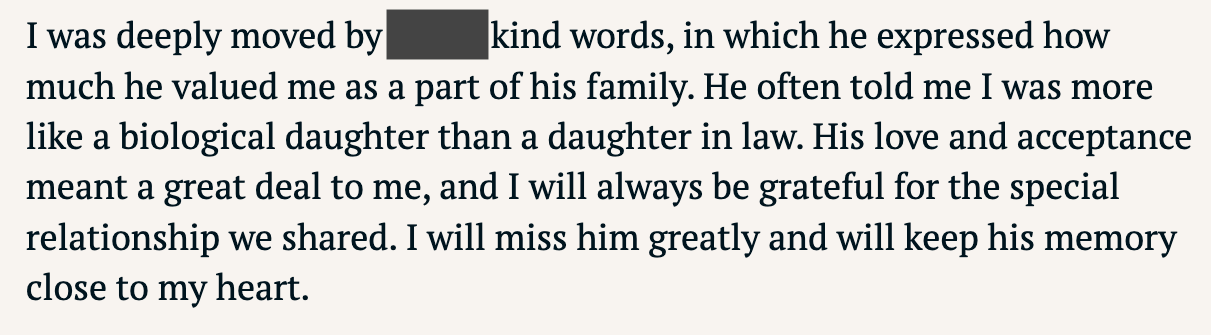
Shortly after the obituary went live, my wife left a comment. It was tender: the kind of language grief uses when it is trying to honor something sacred. Ours was a second marriage, yet my parents had welcomed her with an openness that spoke volumes about their character. In her comment, she wrote about how my father had made room for her in the family. Not just as an addition, but as a fixture.
She shared how he often told her she was more like a biological daughter than a daughter-in-law. It was a thank-you note left in public: a testament to a bond that felt secure because it was based on active choice, not just history. I read it and felt a moment of peace. It felt like a small, safe harbor in the middle of a storm.
The prologue to the void
This wasn’t the first time I had seen the machinery of a high-conflict system meet a moment of family loss. When my mother passed away a few years earlier, my youngest son went to his mother to share his grief. As he recounted it to me, the response he received was four words that I have never been able to forget: “I have no sympathy.”
At the time, I saw it as a singular moment of coldness. Now, I see it as a baseline. In my view, this lack of sympathy creates a jarring distance from a public-facing persona built on professional compassion. While the author markets herself as a specialist in nurturing, I found that the empathetic persona I witnessed in public appeared absent in the private world of a grieving child. By failing to hold space for her son’s grief in that moment, he was left to carry it alone.
The language of relief
So, when my father died, and the atmosphere changed, I wasn’t entirely surprised. I had already seen the lack of sympathy in private. Now, I was watching the performance of it in public.
The occasion of my father’s death became the occasion for creating a different kind of public record on social media. This post was written in the language of “relief” and “closure.” It spoke of suffering “at the hands of another,” utilizing advocacy-based labeling as a moral shield. It was morally armored language: a curated performance designed to look, to an outsider, like a survivor reclaiming their narrative.
In my view, this functions as a ritual of self-affirmation. The attacker isn’t just speaking to an audience. They are speaking to themselves, performing “relief” to validate an internal victim-identity. The irony was jarring: the same heart that had “no sympathy” for a child losing his grandmother was now demanding the world’s sympathy for her own “relief” at the passing of his grandfather.
The chorus that makes it official
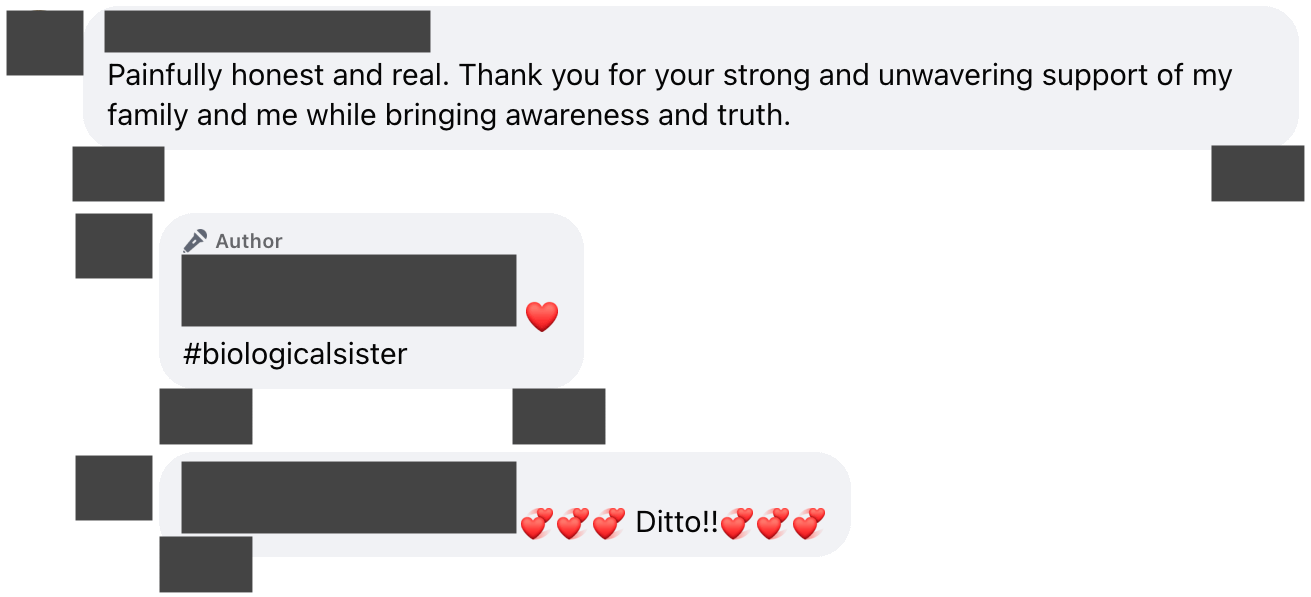
Then, the support arrived. An estranged relative stepped into the comments to validate the post, calling it “painfully honest and real” and thanking the author for their “truth.”
It resembled triangulation to me. In high-conflict dynamics, this relative plays the role of the “Negative Advocate.” They provide the social proof necessary to make a distortion feel like a consensus. A neutral or supportive comment from a relative in this context is an act of bystander validation. It turns a lone voice into a “chorus,” intended to isolate the target by making the rest of the world feel like they’ve already missed a meeting where a vote was taken on who my father was allowed to be.
The “Public” in this scenario isn’t just a faceless audience. It is the inner family circle. The “signal” landed with its greatest impact on my sons. They were the ones who had to witness their grandfather’s memory being used as a stage for narrative control.
The hashtag as a targeted mockery
And then came the part I cannot unsee. My ex-wife stepped into the thread to deliver a reply that looked innocent to a stranger, but landed like a surgical strike on my household. It was a simple hashtag: #biologicalsister.
The timing felt pointed. Four days earlier, my wife had used the word “biological” to describe the depth of her love for my father. Now, that exact word was being used as a label to exclude her. This is “Splitting” in its most surgical form. By emphasizing “biological,” the author creates a hard line between the “all-good” bloodline and the “all-bad” outsiders. Immediately following the hashtag, an estranged member of the family replied with a single word surrounded by hearts: “Ditto!!”
The Probability of Intent: Contextual Triggering
Some might argue this was an innocent coincidence. But in forensic linguistics, we look for the probability of Forensic Mirroring. To estimate the likelihood that the hashtag #biologicalsister appeared by pure chance, we must look at Conditional Probability. The use of that specific rare word appeared not as an independent event, but as a contextually triggered one.
The Window: The post appeared within 96 hours of a specific, public comment about family belonging.
The Mirroring: One post used “biological” to describe an earned bond of love; the subsequent post used the exact same clinical qualifier to enforce a boundary.
If P(A) represents the timing and P(B) represents the linguistic choice, the probability of these co-occurring without influence is statistically negligible. In my view, this wasn’t a random thought: it functioned as a Reactive Response.
The discipline of restraint
I did not respond. Not because I had nothing to say, but because I could feel the old machinery in my chest starting to spin up. I recognized the sensation. It was the beginning of a cognitive loop where the mind replays what the heart cannot accept.
But I realized that attention is the fuel this tactic requires. High-conflict dynamics are rarely about truth. They are about Narrative Control. They are about forcing everyone watching to pick a side in a loyalty test disguised as a status update.
I am practicing a smaller discipline now: the refusal to perform my pain for an audience that has already decided what it wants to see. I am standing in the contested territory of my own mourning, holding onto the truth of my father’s kindness, and refusing to let a hashtag rewrite the history of the man I knew.
Acknowledgments: Special thanks to Dr. Eric Shiraev and the Character Assassination and Reputation Politics (CARP) Research Lab for their analytical feedback on this piece. Their insights on "posthumous self-validation" and the nuances of forensic linguistics were instrumental in refining the logical frameworks presented here.
Author’s Note: This article is a work of personal nonfiction reflecting the author's individual perspective and interpretation of public social media data. The analysis, including probabilistic models and behavioral framing, is provided for educational purposes only and is not an assertion of objective fact regarding the private motives or professional competence of any individuals involved. Names and specific identifiers have been obscured to protect privacy.
A Note on Gender: While I write this from my perspective as a father speaking about an ex-wife, the behaviors of alienation and high-conflict control are gender-neutral. If you are a mother experiencing this, simply swap the pronouns; the pain and the patterns are exactly the same.
Transparency & Privacy Note: The screenshots and behavioral data included in this article are derived from materials published by the subjects in the open public domain. These posts were shared on public-facing social media platforms without privacy restrictions, making them part of the public record. While I have chosen to redact names and identifying markers as a courtesy and an act of personal conscience, the existence of this documentation serves as a verifiable baseline for the behavioral patterns analyzed here.
Resources & Further Reading
Foundational Concepts
Triangles in Family Systems - The Bowen Center for the Study of the Family
Why it’s relevant: Defines the clinical mechanism of triangulation, explaining how three-person dynamics are used to manage tension and create the “communal consensus” described in your article.
Ambiguous Loss: Learning to Live with Unresolved Grief - Dr. Pauline Boss
Why it’s relevant: Explores the complexities of grief in families where relationships are fractured or “unwitnessed,” providing a framework for mourning when there is no closure.
Indirect Aggression and Plausible Deniability - Frontiers in Psychology (Academic)
Why it’s relevant: An in-depth peer-reviewed look at how high-conflict actors use indirect social signals to harm targets while maintaining the ability to deny harmful intent to outsiders.
Practical Guides
Recognize and Understand Online Harassment - Harvard Digital Safety Kit
Why it’s relevant: A professional overview of how online harassment operates and how to identify patterns of digital bullying in public spaces.
Social Media, Cyberbullying, and Online Safety Glossary - Cyberbullying Research Center
Why it’s relevant: Provides clear, expert definitions for “Targeted Mockery” and other digital harassment tactics used to exclude or isolate individuals.
How to Identify a Digital Dog Whistle - DomesticShelters.org
Why it’s relevant: Provides a practical breakdown of how specific words or symbols (like your hashtag example) are used in public to send private, mocking messages to a victim.
Deep Dives
The Anatomy of Post-Mortem Character Assassination - CARP (Character Assassination and Reputation Politics)
Why it’s relevant: Analyzes why high-conflict actors target the deceased to reclaim narratives, directly supporting your analysis of “Grave Dancing”.
Splitting: Protecting Yourself While Divorcing Someone with Borderline or Narcissistic Personality Disorder - Bill Eddy & Randi Kreger (Book)
Why it’s relevant: The definitive text on the “Interpretation Bureau” and how high-conflict alliances use “splitting” to turn family and professionals against a targeted parent.