

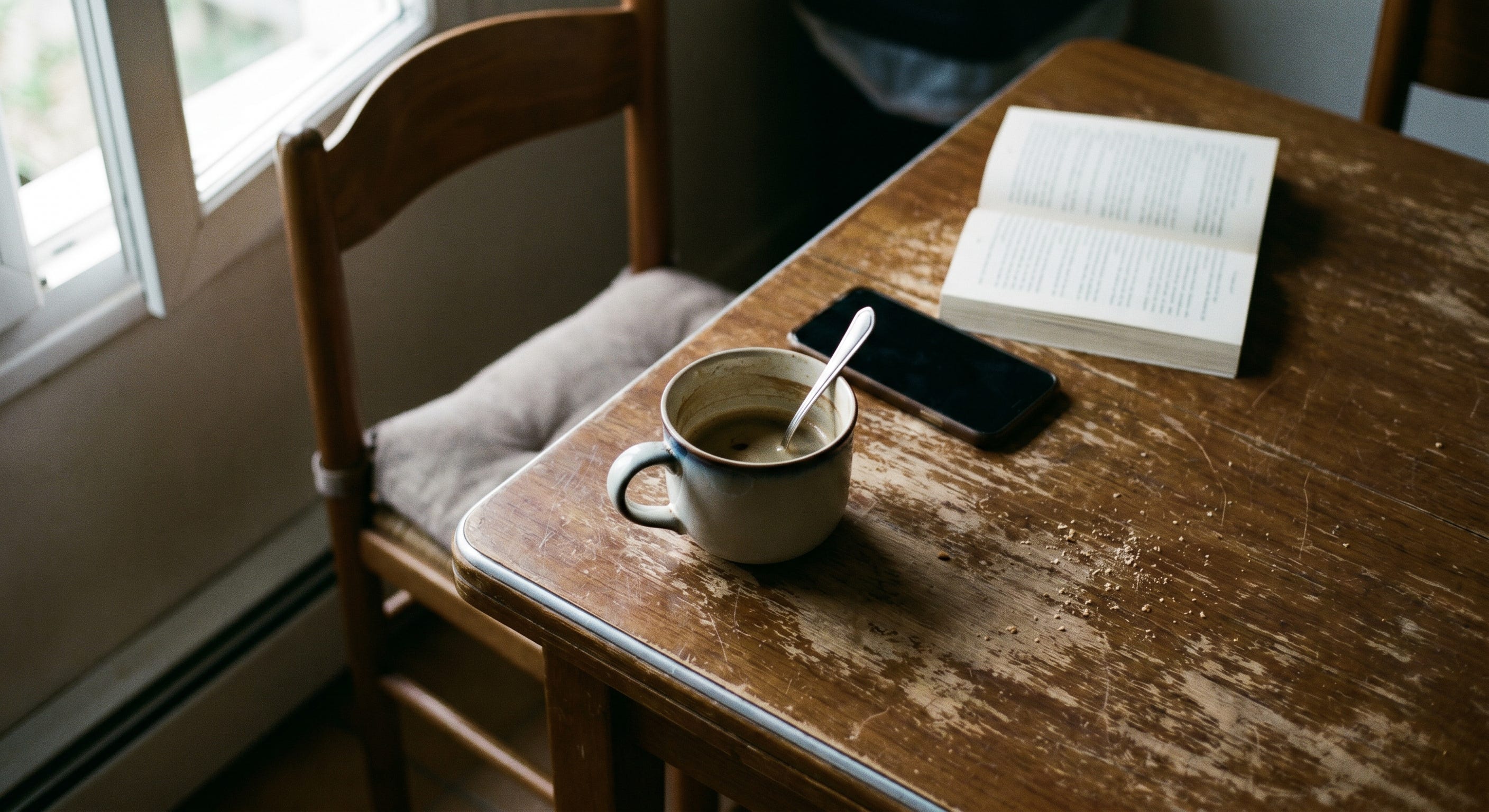
There was a Father’s Day, I don’t remember which one exactly, when I realized I hadn’t checked my phone in two hours. I was reading something at the kitchen table. The coffee was still warm. The day was already half over.
That was the first year I didn’t wait.
What the Day Used to Feel Like
The feeling was there before I opened my eyes.
Not sadness, not exactly. Something closer to a held breath. A low-level alertness that settled over everything by the time I got to the kitchen. Phone close by. Coffee going cold while I was somewhere else in my head.
I used to run a quiet mathematics. If they texted by 9, it meant something. By noon, it still counted. By 3, I’d started explaining it to myself: they’re busy, they probably forgot, they’ll remember later. By evening I’d stopped checking, but not because I’d given up. I’d just temporarily run out of whatever internal resource is required to keep hoping on a schedule.
June has always arrived differently for me. Not like a door opening. Like a door I keep watching from across the room.
For a while I filled the day deliberately. Brunch somewhere, a project in the garage, a long drive with music playing loud enough that I wasn’t just sitting with the quiet. Things that made the day feel chosen rather than endured. But the checking happened anyway, between the other things. One eye on the activity, one eye on my pocket.
The hope had its own internal logic. They were young. The situation was what it was. One year they’d call, unprompted, and something in the room would shift.
The Invisible Threshold
I don’t know which Father’s Day it was when the waiting stopped.
That’s the honest answer. There wasn’t a morning I decided. No particular Sunday when I set the phone face-down and thought: that’s enough. It happened gradually, over several Junes, in a way that only became visible in retrospect. One year I noticed the phone was just a phone again. I’d been reading for two hours. The day was most of the way through.
What I felt was the absence of the held breath.
That’s what I mean when I say I stopped waiting. Not that I stopped wanting. The wanting doesn’t disappear; it just stops organizing the day around itself. What let go was the ritual: the counting, the mathematics of hope calibrated by the hour, the mental ledger of what a late text means versus no text at all. That part let go quietly, without my permission.
And yet I want to be careful about what I’m saying here. The end of waiting isn’t indifference. It doesn’t mean the day stopped having weight. What changed is the nature of the weight: from something acute and attended to, to something carried the way you carry any old thing. Present, but not managed by the hour.
I won’t call it healing. I don’t know what the right word is. It’s closer to the difference between actively bleeding and living with a scar. The scar is still there. It just doesn’t require the same daily management.
The Monday After
There’s something that happens the Monday after Father’s Day that I wasn’t prepared for the first time it hit.
You go back to work. People ask how your weekend was. It’s ordinary small talk; they’re not asking about you specifically. But on this particular Monday, the question carries something it doesn’t carry any other week of the year.
“Good,” you say. “Quiet weekend.” Which is true. And then someone mentions what their kids did for them, and someone else shows a photo on their phone from brunch with their dad, and you’re standing at the counter holding your coffee and doing math you didn’t mean to start: I am in this room. I am not in this story. No one here knows that. I’m not going to tell them.
That’s a specific kind of invisible. The estrangement is private most of the time: no category anyone recognizes, no ritual of public acknowledgment, no name for it in the ordinary conversation you have with someone you see every day. Father’s Day is the one week when it surfaces briefly, in break rooms and parking lots and in the feed you scroll before you put your phone down. You navigate all of it alone without being able to explain why you’re navigating anything at all.
The first time the Monday hit, I wasn’t ready. By the third or fourth year I’d learned the shape of it: not wisdom exactly, more like topography. I know where the drop is now. I know it’s coming. I know what it costs and what to do with it by 5.
What Remains
Father’s Day doesn’t measure fatherhood.
It measures contact: what reached you on that specific Sunday. What didn’t. The calendar has no record of the texts sent on ordinary Tuesdays with no expectation of reply. It doesn’t account for the documentation kept, the restraint practiced, the door held open across years without anyone walking through it.
The day is a marker, not a verdict.
There’s a version of fatherhood that runs entirely on contact: calls made, visits scheduled, presence that shows up on a calendar. I’ve been outside that version for a long time. What I’m left with is quieter. It runs on the decision not to disappear, not to retaliate, not to stop being the person they could come back to.
I’ve stopped expecting Father’s Day to tell me something I don’t already know. I know their voices at different ages. I remember the specific weight of presence in a room when they were in it. I know when the pattern started and what I believe shaped it. I know what I did in response and what I chose not to.
The day arrives whether or not anything changes. It used to feel like a sentence being read out. Now it just feels like a Sunday with a particular weight.
I am still their father. The calendar doesn’t decide that.
Author’s Note
This article is a work of personal nonfiction based on my own memory, correspondence, and documentation. It reflects my individual perspective and experience and is not intended as legal or psychological advice. Some names, timelines, or identifying details may have been changed to protect the privacy of all involved.
A note on gender: while I write from my perspective as a father, the patterns of alienation and estrangement are not gender-specific. If you’re a mother in a similar situation, simply swap the pronouns; the weight of it is exactly the same.