

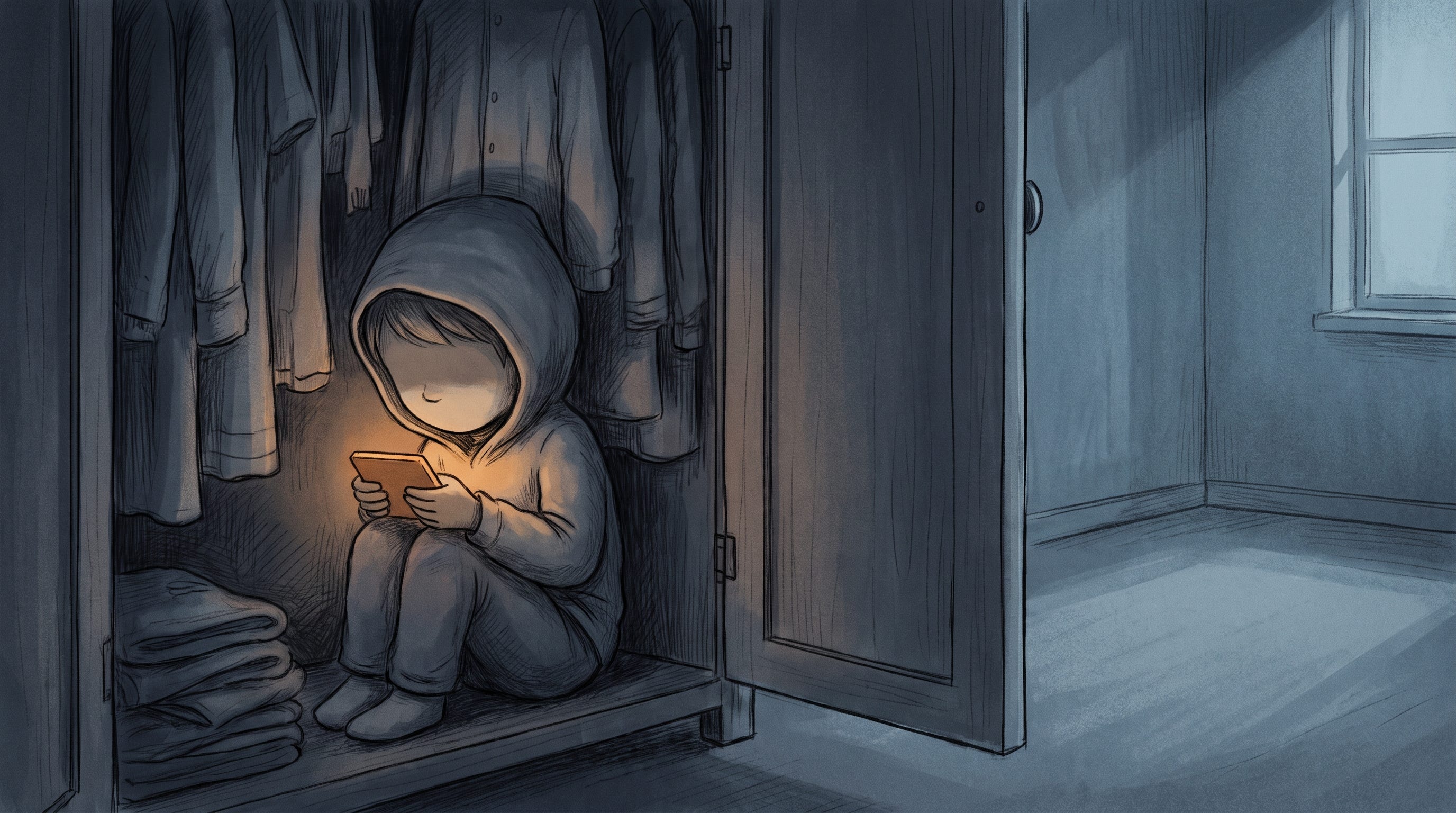
My youngest son called me from a closet once.
He kept his voice down, because if his mom’s boyfriend heard him talking to me there would be a price, and my son already knew the exchange rate. He was a kid. He’d worked out, the way kids work out weather, that his father was someone you contacted carefully, in the dark, with the door shut.
Last week I wrote that the phone was never the problem. The open line to me was. This is the part I couldn’t fit in that piece: what happened to my son when he used the line anyway.
The call that got him punished
Another time, he called me because his computer was broken. Ordinary kid stuff. I was a few minutes into walking him through it, the way you do, when I heard her voice come up sharp behind him, and then the line went dead.
He told me later that he’d been punished for it. For calling his father about a computer. He was told not to do that again.
I want to stay on that a second, because it’s easy to read straight past. A child reached out to a parent for help with a machine, and the reaching was the offense. Not what was said on the call. The call itself. It felt like the contact was the crime.
I can’t tell you what was in her head. I’ve stopped pretending I can. But I can tell you what a kid takes from a thing like that, because it isn’t complicated and it isn’t really in dispute. He learns that the safe move is not to call. He learns it once, in his body, and he doesn’t need the lesson twice.
What it actually is
There’s a name for arranging a person’s life so that contact with the outside gets punished until they stop trying. Last week I brought up the term coercive control, and I stand on that. The people who study it, Evan Stark chief among them, describe a pattern built out of isolation, surveillance and punishment, run until the other person’s world has shrunk to the size you allow. Run it long enough and the target stops being a person in the story at all. In my case, I’ve been erased from it.
Point that at a child and the research is blunt about it. After a separation, one of the moves it describes is turning the kids into instruments, which makes them the weapon and the wound at the same time. Family courts still tend to file it under “high conflict,” as though it were two grown-ups being equally difficult. In my view it isn’t symmetrical at all. One person is running the machine. The other is a boy in a closet.
Sometimes I think she knew exactly what she was building. Sometimes I think she’d lived inside her own story so long that punishing a computer call felt to her like loving her kids. I can’t always tell which. My son learned to whisper either way, and as a grown man he’s since gone quiet with me. The silence now is a different story, and a harder one, with more than one author. That part isn’t mine to tell here. This article is about something older and simpler: who taught him, when he was small, that reaching me had a price.
The pattern under the incidents
None of this began with the closet, and the notes I kept at the time show the runway.
There’s an entry from when he was small, at a gas station, where he was afraid to ask me if he could use the bathroom, because the last time he’d asked his mom that same question she’d gotten angry and he hadn’t been allowed to go. There’s another where a melted phone charger showed up in the mail when his mom and I were separated. He was visibly scared of how she’d react. Then, quiet, he said what his older brother had already told me: she wouldn’t answer his calls and wouldn’t call back anyway. There were the secret phones. It appeared to me, every time, that he was being aggressively pressed for where we’d gone and what we’d done while he was with me.
Years later, on a recording my son made himself without anyone asking, you can hear the shape of it hold. He admits he’d hidden his visits with me and our family trips for years, and when she asks him why, he says it plainly. It was out of fear … fear of her. At one point she tells him she’s sorry for ever making him feel he had to be quiet with her. I’ve gone back to that line more than once. It’s the closest thing to an admission in the whole archive, and it slid by like weather too.
The container
Here’s a small one, because the small ones tell the truth faster.
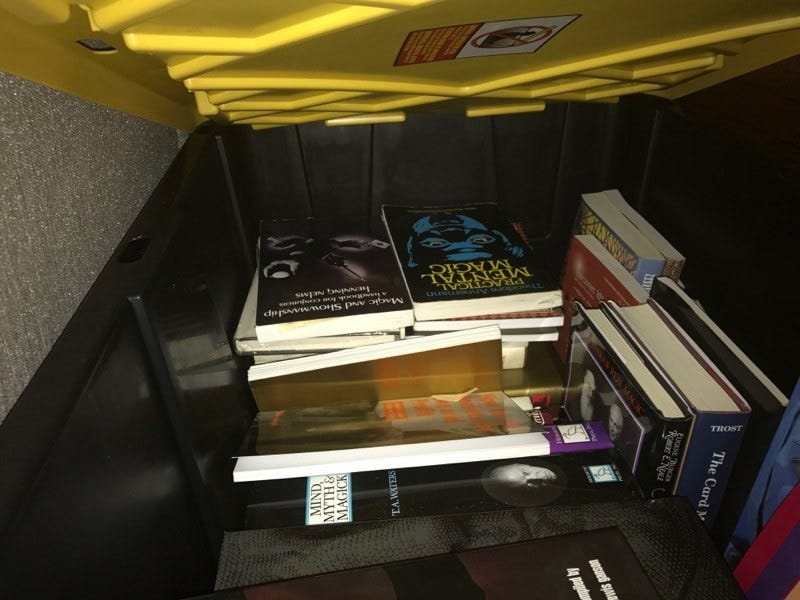
When we separated, she ended up with a couple of containers of my magic tricks and books. Close-up gear, stage pieces, old books, some of them belonging to my brother and dating back to the seventies, before he died of leukemia in November 1980. I asked for it back. My attorney asked, in writing, more than once. A court ordered her to return my property. And every time, the answer came back worded with a little too much care: she’d returned everything in her “possession”.
Which was true, in the way a magician’s or charlatan’s sentence is true. The things weren’t in her possession. They were at her mother’s house, and in a storage unit, and later her boyfriend’s house, which meant the words held up even as the containers didn’t move.
My son knew where they were. On one of our exchanges he quietly handed me a few of the pieces, and when I asked whether his mom knew he was giving them back, he said no, she didn’t. Then he showed me the rest, photos and a short video of my own things sitting in someone else’s house, so I’d know they were real. A kid smuggling a couple of his father’s belongings back to him a handful at a time, while the adult in charge told a court she’d returned all of it.
I’ve written before about this exact species of thing. The version where she went to my employer with the attempt to get my wife and I fired. The version where the money story came apart the second you set it next to the record. The magic is the same animal, just smaller, and somehow clearer for being small. Who parses a sentence that carefully over a dead man’s magic books? Someone for whom the lie is the reflex and the truth is a thing you route around, on the things that matter and the things that don’t. The current version is her telling the boys that a cease-and-desist letter bars her from contacting me. It doesn’t say that. It never did. It was a letter asking her to leave us alone, not a rule about who she’s allowed to call. The story just has to be something other than what the paper says.
That’s the whole discipline I’ve had to learn. Put the record next to the story, and let the record do the talking.
What it cost
Here’s what I keep landing on. In my view a boy in a closet is not a custody arrangement. He’s a child who has decided that loving one of his parents is dangerous, and has taken it underground to survive.
He isn’t the villain here, and neither, in the end, is a frightened kid who stopped calling. He ran the math a child should never be handed, and my name was in the cost column. That it worked isn’t evidence he stopped loving me. It’s evidence of what was done to him.
He’s a grown man now, and the silence he keeps is his to keep. I only mean the man inherited the boy’s wiring, and nobody asked the boy.
The magic containers are gone. I quit asking for them a long time ago. What I haven’t quit is keeping the line open on my end, the same number he once had to shut a door to dial, in case a day comes when he doesn’t have to whisper anymore.
Author’s Note
This article is a work of personal nonfiction based on my own memory, correspondence and contemporaneous documentation. It reflects my individual perspective and experience, and is not intended as legal or psychological advice. Names, dates and identifying details have been changed or withheld to protect the privacy of everyone involved, including my children.
A note on gender: I write from my perspective as a father, but the patterns of coercive control and estrangement are not gender-specific. If you are a mother living through something like this, the weight of it belongs to you too.