


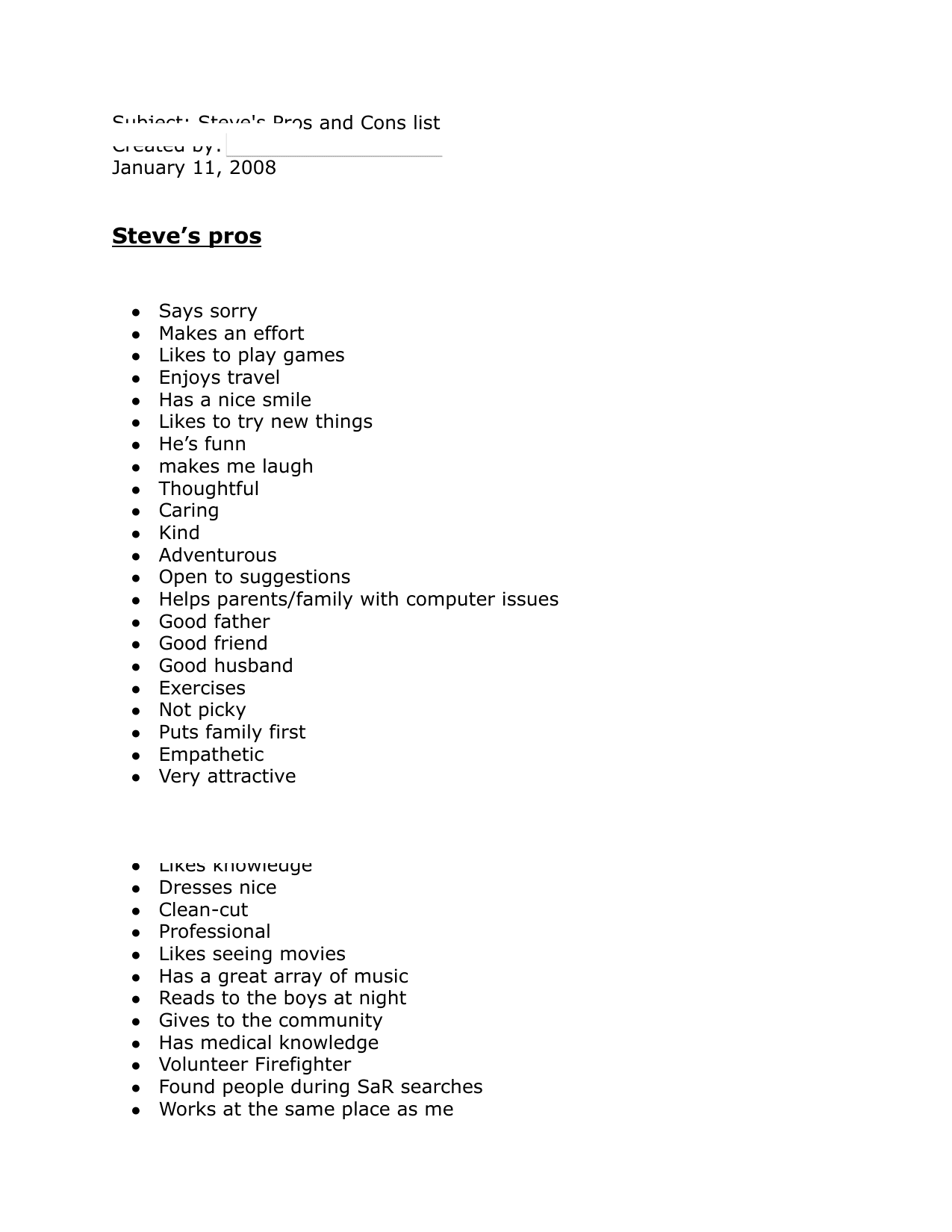
In January 2008, my then-wife sat down and made a list.
It was a marriage exercise. The kind therapists recommend when couples are trying to understand each other better. She made two documents: one listing her own pros and cons, and one listing mine.
I still have them.
What she wrote
Her list of my qualities ran to fifty-four items. I will share a few:
Good father
Good husband
Good friend
Puts family first
Reads to the boys at night
Caring
Kind
Empathetic
Tolerant
Thoughtful
Provider for the family
Gives to the community
Volunteer Firefighter
Found people during Search and Rescue
She also listed cons. Twenty-three of them. They included:
Works too much
Overwhelmed with work
Can’t pause a project once he starts
Doesn’t share all his feelings
Stretches himself too thin
These are the complaints of a wife who wishes her husband would relax more. They are not the complaints of a woman living with a monster.
There is nothing in that list about violence. Nothing about abuse. Nothing about neglect. Nothing about bad parenting. Nothing about temper.
The worst thing she could say about me in 2008 was that I worked too hard.
What they said
Three years later, in February 2011, the divorce was underway. I was recording calls through Google Voice, not because I anticipated what was coming, but because I wanted to remember their voices.
My younger son called one evening while I was in the shower:
“Hey, just saying good night. You don’t have to call back if you’re busy. I just wanted to say good night. I love you. Bye. Good night, Dad.”
Twenty-eight seconds. A child calling his father to say goodnight. Nothing remarkable. Nothing strained. Just a boy who wanted to hear his dad’s voice before bed.
In April, another call while my phone was rebooting:
“Hey Dad, just calling. Saying good night. We could talk to you tomorrow. The day was fine. Just a normal Monday. Bye.”
These recordings exist. I have them. The voices of my children, calling me, saying goodnight, saying they love me.
This is what the relationship sounded like before the narrative changed.
What I documented
That summer, I kept a journal. Every day of custody time, I wrote down what we did. Not because I was building a case. Because I wanted to remember.
June 2011. The boys came for their summer visit. I documented:
Meals I cooked. Eggs, bacon, pancakes, quesadillas on the grill.
Activities. Summer camp drop-offs. A trip to Great America. Movies. Beach days.
Conversations. Real ones. About school, about friends, about life.
My younger son told me he saw my now stepson “like a brother” and my now wife “like a step-mom.” He said he “really liked her.”
My older son asked for another sleepover at our house. He said he “really wanted” to stay longer.
The journal describes boys who were “smiling a lot, laughing a lot, and talking a lot.”
I also documented something else: nearly every day, I reminded them to call their mom. I have the entries. “Reminded the boys to call their mom.” “Had the boys call their mom at 9:30 PM.”
I was not blocking contact. I was facilitating it.
What changed
Seven weeks after that summer journal ended, my older son posted publicly on Facebook:
“If Morality Could Be Physically Shown, My Dad Would Have Demon Horns.”
His mother replied, also publicly: “Spoken like a true wise man.”
The same woman who wrote “good father, puts family first, reads to the boys at night” was now praising her son for calling me a demon.
The same boys who called to say “I love you, good night, Dad” were now describing my house as “the demon’s lair” and their visits as something to “survive.”
I have the screenshots. I have the timestamps. August 2011. It was during the second half of summer that wasn’t my custody time. The same summer the journal recorded them smiling, laughing, asking for sleepovers.
What happened in those eight weeks?
They went back to their mother’s house.
The record remains
I cannot make anyone read these documents. I cannot force the world to compare the before and after.
But I can keep them.
The pros and cons list, written in her own words. The call recordings, in their own voices. The journal, in my own handwriting. The Facebook posts, in public view.
The narrative says I was a demon. The record says I was a father who read to his boys at night, who cooked them breakfast, who reminded them to call their mom, who documented every moment because he knew, somehow, that one day the truth might need witnesses.
I was not perfect. I worked too much. I stretched myself too thin. I didn’t always share my feelings.
But I was not a demon.
And she knew it. She wrote it down.
Author’s Note: This article is a work of personal nonfiction based on my own memory, correspondence, and documentation. It reflects my individual perspective and experience, and is not intended as legal or psychological advice. Some names, timelines, or identifying details may have been changed to protect the privacy of all involved.
A Note on Gender: While I write this from my perspective as a father speaking about an ex-wife, the behaviors of alienation and high-conflict control are gender-neutral. If you are a mother experiencing this, simply swap the pronouns; the pain and the patterns are exactly the same.
Resources & Further Reading
Foundational Concepts
The Eight Manifestations of Parental Alienation — Dr. Richard Warshak
Why it’s relevant: Warshak’s research identifies the behavioral markers of alienation, including the sudden shift from loving relationship to demonization. This article demonstrates several manifestations.
Parental Alienation: The Handbook for Mental Health and Legal Professionals — Demosthenes Lorandos, William Bernet, S. Richard Sauber
Why it’s relevant: The clinical standard for understanding how loving parent-child relationships are systematically destroyed through alienation tactics.
Practical Guidance
How to Prove Parental Alienation — Shapiro Family Law
Why it’s relevant: Documentation matters. This guide explains why contemporaneous records like journals, call logs, and written assessments are critical evidence.
Documenting Parental Alienation: What Courts Need to See — Psychology Today
Why it’s relevant: Practical advice on what to document and how, directly applicable to the evidence types shown in this article.
Deep Dives
Divorce Poison: How to Protect Your Family from Bad-mouthing and Brainwashing — Dr. Richard Warshak
Why it’s relevant: The definitive guide for targeted parents, explaining how children are turned against a loving parent and what can be done about it.
Rules of Estrangement — Joshua Coleman, PhD (Penguin Random House)
Why it’s relevant: Coleman addresses the transformation of parent-child relationships and the role of narrative control in family estrangement.