


Every night, before sleep, I run through the same quiet inventory.
I start with the house. The walls that keep out the cold. The roof that holds the rain. Small gratitudes, easy ones. Then wider: the earth itself, the ground that grows everything we eat, the air we breathe without thinking.
Then the ancestors. My mother. My father. Both gone now. I exist because they existed. Their parents before them. And their parents. Generations I will never know, stretching back through centuries, all of them necessary for me to be lying here, in this bed, doing this practice.
And then the people in my life. My wife. My children.
I say my children’s names in my head. All three of them. Every night.
One answers when I call. Two do not.
No one sees this. No one knows. There is no audience for this love, no witness to confirm it happened. It is a ritual performed in the dark, for no one but myself.
The artifacts of presence
In my home office, tucked between books and old hard drives, there are objects that have no practical purpose anymore.
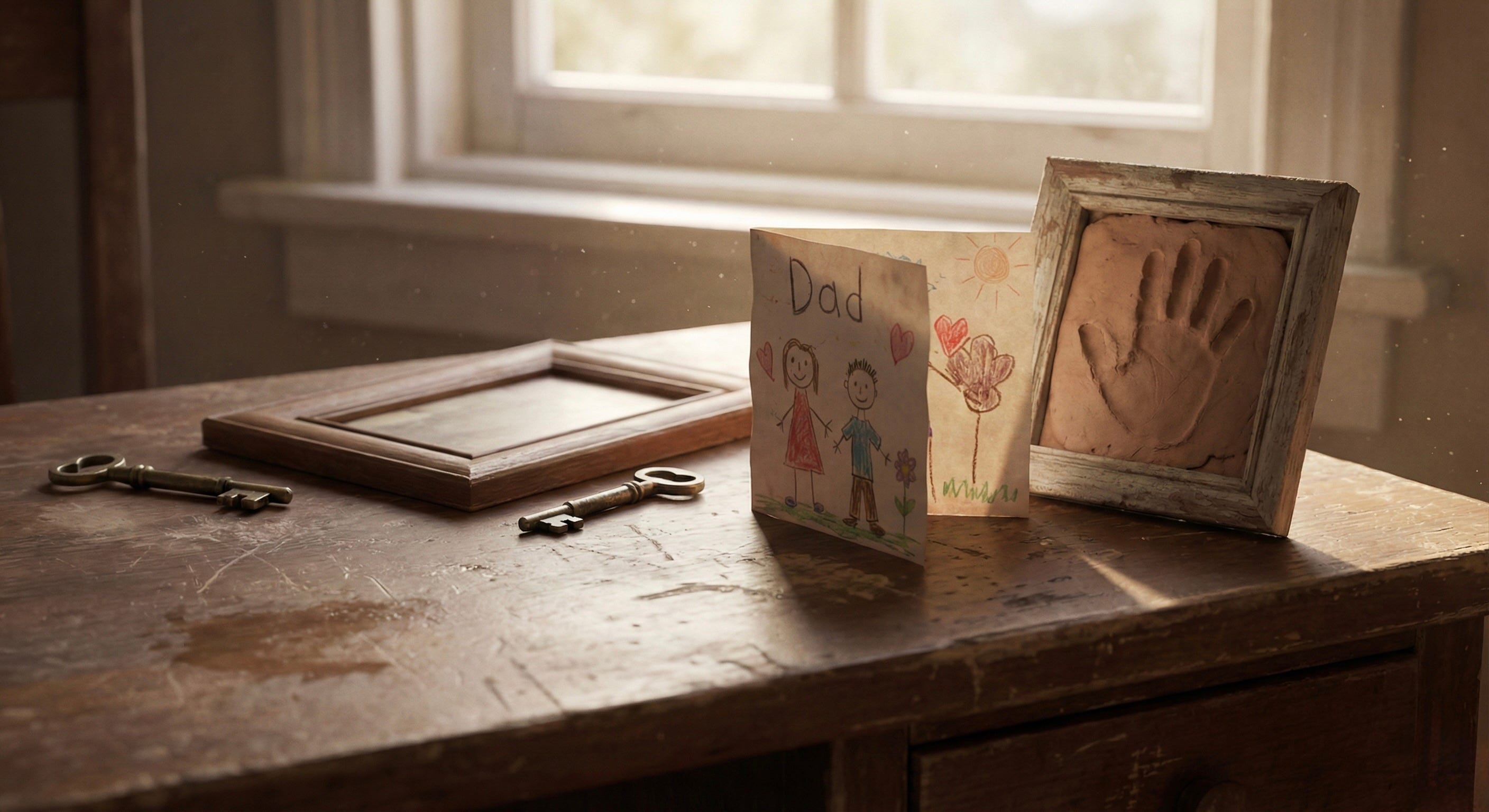
A Father’s Day card made from construction paper. The handwriting is uneven, the glue visible where the edges didn’t quite hold. A crayon drawing of a stick figure family, four shapes holding hands under a yellow sun. A clay handprint, cracked now, from a school project I can no longer date.
I could throw these away. They serve no function. The children who made them are grown. The hands that shaped that clay are adult hands now, hands that have not touched mine in years.
But I keep them. Not as shrines. Not as evidence of better times. I keep them because, to me, they are proof that I was there. That we were a family once, whatever the current story says.
Some nights, I pick one up. I don’t linger. I don’t cry. I just hold it for a moment, then put it back.
A ritual so small it barely registers as one.
The photographs I return to
There is a folder on my phone labeled with a year. Inside are photographs from a trip we took when the boys were young. Camping. Hiking. The kind of trip that felt ordinary at the time.
I did not know, then, that I was building an archive. I did not know that these images would become, at least as I experienced it, the only record of a relationship that would later be erased from the official story.
I scroll through them sometimes. Not to mourn. Not exactly. More like visiting a place that no longer exists on any map.
Here is my older son at the edge of a lake, squinting into the sun. Here is my younger son laughing at something I said. Here is a moment that happened, that was real, that no one can take away.
The photographs do not bring them back. They do not soften the silence. But they remind me that the silence is not the whole story.
What rituals are for
Rituals are how we hold onto meaning when the meaning has been taken from us.
In a normal family, gratitude flows outward. You tell people you love them, and they hear it. You celebrate birthdays together. You mark the milestones in real time, with real presence.
But in estrangement, love has nowhere to go. The connection is severed. The audience is gone. And yet the love remains, circling inside you with no outlet.
So you invent rituals to contain it.
I say their names in the dark. I keep their childhood drawings. I scroll through old photos on quiet evenings. None of it changes anything. None of it brings them closer. None of it will ever be seen, acknowledged, or rewarded.
That is not the point.
The point is to stay who I am. To keep practicing love, even when it has no recipient. To refuse to let the estrangement harden me into someone who no longer cares.
The ache that stays
Some nights, after the gratitude practice, I lie awake.
Not because the ritual failed. Because it worked. Because I felt I touched something real, and the realness of it cut through the distance. Because I said their names, and for a moment they were present, and then they were gone again.
This is the cost of ritual without witness. You carry the love alone. You hold the thread even when no one is pulling on the other end. You do not get to know if it matters.
I do it anyway.
Not because I believe they will come back. Not because I expect the silence to break. But because I refuse to let the estrangement define what kind of father I am.
They may never know that I do this. They may never learn that their names are spoken in the dark, every night, in gratitude. They may grow old believing the story they were told.
But I will know.
And I will keep the ritual, even if it never gets rewarded.
Author’s Note: This article is a work of personal nonfiction based on my own memory, correspondence, and documentation. It reflects my individual perspective and experience, and is not intended as legal or psychological advice. Some names, timelines, or identifying details may have been changed to protect the privacy of all involved.
A Note on Gender: While I write this from my perspective as a father speaking about an ex-wife, the behaviors of alienation and high-conflict control are gender-neutral. If you are a mother experiencing this, simply swap the pronouns; the pain and the patterns are exactly the same.
Resources & Further Reading
Foundational Concepts
Ambiguous Loss — Dr. Pauline Boss
Why it’s relevant: Boss’s foundational work on losses that lack closure. Estrangement is a form of ambiguous loss: the person is alive, but the relationship is gone. Understanding this helps name the grief.
Continuing Bonds Theory in Grief Counselling — The Loss Foundation
Why it’s relevant: This theory proposes that maintaining connection to someone lost (through rituals, objects, memories) is healthy, not pathological. Directly supports the practice of unwitnessed rituals.
Disenfranchised Grief — Kenneth Doka / The Loss Foundation
Why it’s relevant: Estrangement grief is rarely acknowledged socially. Doka’s concept names the isolation of grieving losses that others don’t recognize.
Practical Guidance
Pauline Boss: Navigating Loss Without Closure — On Being (Krista Tippett)
Why it’s relevant: A long-form interview exploring how to live with losses that never resolve. Discusses the myth of closure and the importance of meaning-making.
How to Reconcile With Your Estranged Adult Child — AARP
Why it’s relevant: Practical guidance for parents navigating estrangement, including the value of “reaching out infrequently but authentically.”
Deep Dives
Continuing Bonds: New Understandings of Grief — Klass, Silverman & Nickman (Routledge)
Why it’s relevant: The academic text that established continuing bonds theory. Challenges the 20th-century model that grief requires severing ties.
Rules of Estrangement — Joshua Coleman, PhD (Penguin Random House)
Why it’s relevant: Coleman addresses how estranged parents can maintain their identity and practice love even without reciprocation.