


A couple months ago, I wrote about why I did not reach out to my sons at Christmas. I described the holiday not as a celebration, but as a symbol-heavy minefield. For an alienated parent, the holidays are often less about connection and more about a ritualized performance. We send a message, we wait, we interpret the silence, we ache, and then we spiral.
In that piece, I argued that silence was an act of coherence. It was a refusal to participate in a transaction where my hope was the currency and my disappointment was the tax.
But then, on an ordinary day... a day with no calendar significance and no ritual expectations... I picked up my phone. I sent a single text to both of my adult sons.
“Hi [Name]. I love you. I think of you every day.”
No ask. No pressure. No reference to the legal dockets, the trust disputes, or the external influences that have spent years rewriting my history. Just a signal.
The Difference Between Reaching Out and Reaching
There is a profound, often ignored distinction between “reaching out” and “reaching.”
Reaching is an act of hunger. It is pursuit. When we reach, we are trying to extract something from the other person: a reply, a validation, a sign that the bond still has a pulse. Reaching is loud. It has hooks. It says, “I love you,” but it is often followed by an unspoken, “...and why haven’t you called me back?”
Reaching out, however, is an act of presence. It is an open hand, not a grasping one.
In the high-conflict ecosystem I have navigated for years, “reaching” can be risky. I have seen how my vulnerability can be harvested. I have been provided with email threads where a sibling forwarded my private pleas for peace to my ex-spouse and a professional, counting my “I statements” as if they were evidence of a crime. In that world, reaching is often viewed as a weakness to be exploited.
Coherent contact is different. It is a message sent with the full knowledge that it will likely be met with silence. It is “coherent” because it matches my internal truth without requiring the other person to change theirs.
The Risk of the Digital Signal
I am under no illusions about how these messages may be received. In a system built on alienation, even a four-word text… ”I think of you”… is often run through an interpretation filter. I know that as soon as I hit send, my words may be forwarded and reframed as a performance or a “calculated move.”
I know that by writing this, I am giving what I call the “Interpretation Bureau” more material to work with. There is a risk that this outreach will be presented to my sons as “content” for an article, or a way to project an image to a public audience.
But I have decided that I cannot let a potential distortion of my truth dictate my actions. If I stop saying “I love you” because I am afraid of how it will be spun, then the alienation has won. I am not writing for the version of them that is currently under the influence of a false narrative; I am writing for the internal record.
I am writing so that one day, when they look back, they will see a consistent, unwavering line of presence that refused to be intimidated into silence. And I must accept the possibility that they may not. They may remain within a narrative that has no room for my truth, or under the weight of a history I did not write.
The Ordinary Day Test
Why any ordinary day? Why not Christmas?
Christmas is a performance. On a holiday, a message carries the weight of “The Way Things Should Be.” It carries a perceived demand for reconciliation. It invites the recipient to feel guilt or the sender to feel like a martyr.
But a day in the “Long Middle” of estrangement has no such weight. By choosing a random afternoon, I am signaling that my love is a baseline, not a special occasion. It is a part of the atmosphere, like oxygen or gravity.
I sat in my office, staring at the blue bubbles on the screen. I didn’t check for “Read Receipts.” I didn’t stare at the three dots of a typing indicator. I sent the messages, put the phone face down on the desk, and went back to work.
The discipline of coherent contact is the refusal to narrativize the silence that follows.

Non-Response is Not an Answer
Neither of my sons replied.
In the past, that silence would have felt like a verdict. I would have viewed it as proof of the “extraction” the mediator described during a past dispute... the attempt to strip me of my reputation and my peace of mind. I would have imagined them showing the screen to others, perhaps viewing the message through a lens of “narcissism” or dismissing the father who still thinks he has a role.
But coherent contact requires outcome-independence. If I only say “I love you” because I want to hear it back, I am not giving a gift; I am making a trade. And in alienation, you cannot trade with people who have been taught to believe your currency is counterfeit.
I have had to learn how to metabolize that non-response. It isn’t a “no.” It isn’t a “yes.” It is simply what is. By sending the one-sentence text, I am keeping the door unlocked from my side. Whether they choose to walk through it, or even look at the handle, is their autonomy to exercise. I am respecting their current reality while refusing to let it dictate my own.
A Framework for Stance
For anyone living in this quiet war, I propose a set of rules for “Coherent Contact”:
No “And also...”: If you say I love you, say I love you. Do not add a request for a meeting, a question about their life, or a reminder of the past.
Hope vs. Expectation: Allow yourself the human grace of hope… the quiet wish for a future connection… but carry zero expectation of a present reply. Hope keeps the heart open; expectation gives the silence power to crush you.
Nervous-System Honesty: Do not send the text if you are “reaching” for relief. Only send it if you can handle the silence that follows without collapsing.
Autonomy-Respect: Accept that non-response is a valid exercise of their current boundary, even if that boundary was built on a narrative you didn’t create.
Non-Triangulation: Send the messages individually. Do not mention one sibling to the other. Hold each relationship in its own clean space.
Silence was never the absence of love. It was the refusal to trade my integrity for temporary relief. And sometimes love is one sentence... precisely because it asks for nothing back.
Author’s Note This article is a work of personal nonfiction based on my own memory, correspondence, and documentation. It reflects my individual perspective and experience, and is not intended as legal or psychological advice. Some names, timelines, or identifying details may have been changed to protect the privacy of all involved.
A Note on Gender: While I write this from my perspective as a father speaking about an ex-wife, the behaviors of alienation and high-conflict control are gender-neutral. If you are a mother experiencing this, simply swap the pronouns; the pain and the patterns are exactly the same.
Resources & Further Reading
Foundational Concepts
Ambiguous Loss: Learning to Live with Unresolved Grief — Dr. Pauline Boss Why it’s relevant: Provides the foundational psychological framework for “ambiguous loss,” where loved ones are physically present but psychologically absent, helping to contextualize the “Long Middle” of estrangement.
Triangles and Triangulation in Family Systems — The Bowen Center for the Study of the Family Why it’s relevant: Defines the clinical “Architecture of Triangulation” mentioned in your article, explaining how high-conflict systems recruit third parties to shift focus and manage tension.
Practical Guides & Stance
BIFF: Quick Responses to High-Conflict People — Bill Eddy / High Conflict Institute Why it’s relevant: Offers a structured communication method (Brief, Informative, Friendly, and Firm) that aligns with the “Coherent Contact” rules for staying out of the “Interpretation Bureau’s” reach.
Surviving Parental Alienation: A Resource Guide — Psychology Today Why it’s relevant: A practical resource for parents navigating the “quiet war,” offering strategies for maintaining self-regulation and outcome-independence.
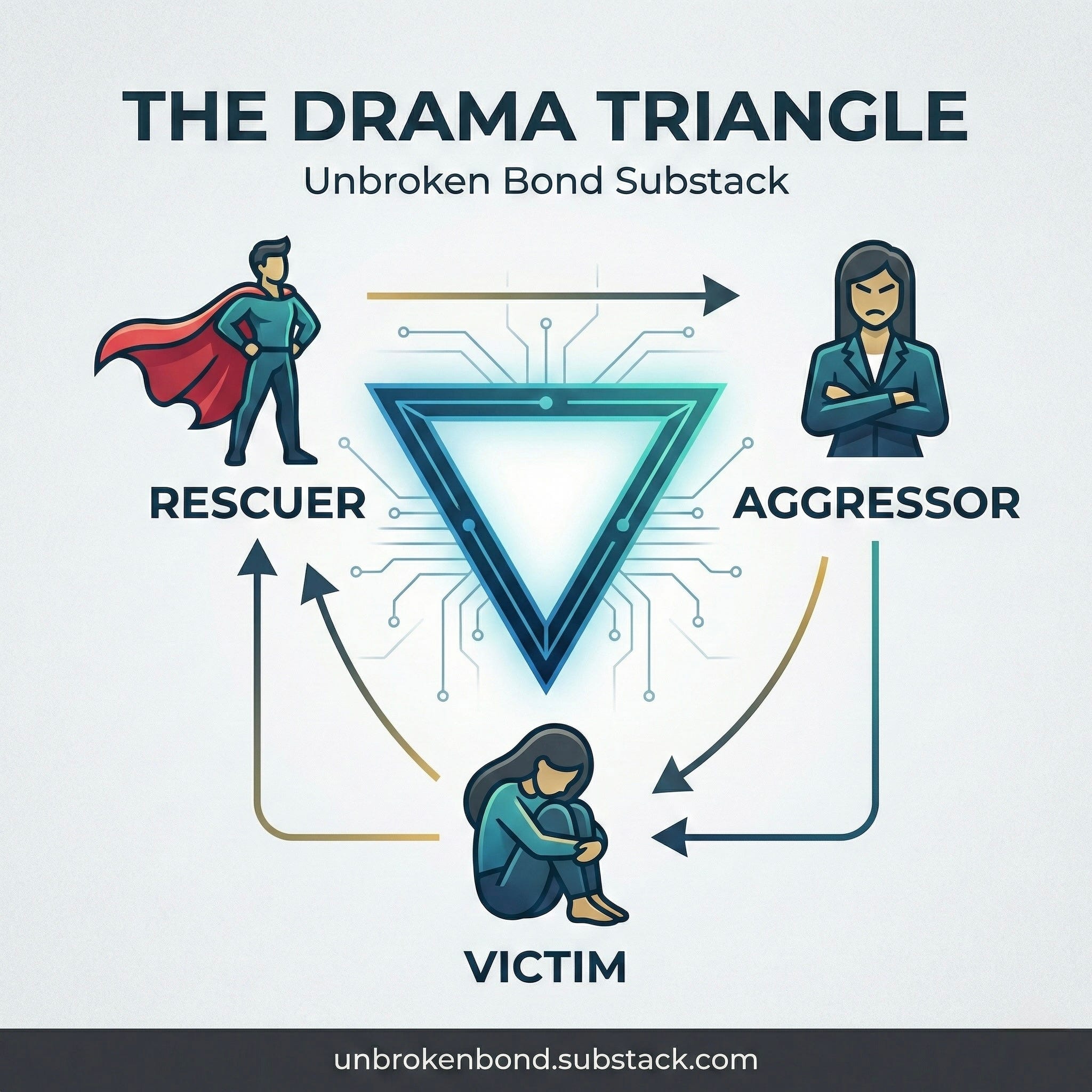
Understanding the Drama Triangle — BPDFamily Why it’s relevant: Helps readers visualize the “performance” and “martyr” roles described, providing a way to step out of the ritualized transaction of hope and disappointment.
Deep Dives & Research
Parental Alienation and the Bystander Effect — PubMed Central (NIH) Why it’s relevant: An academic look at how family members and professionals become “Negative Advocates” or “recruiters” in alienation systems, mirroring my experiences with the “Interpretation Bureau.”
Same Family, Divergent Realities: How Triangulation Preserves Illusory Harmony — Frontiers in Psychology Why it’s relevant: A research-level exploration of how family systems rewrite history and create false narratives to maintain a specific alignment, validating the “Ordinary Day” signals.
Recommended Book
Why Does He Do That? Inside the Minds of Angry and Controlling Men — Lundy Bancroft Why it’s relevant: While gender-neutral in the article’s application, Bancroft’s work is the definitive text on how abusers “harvest” vulnerability and use information as currency to alienate children.
Beautifully written. I text my children almost every week to let them know I love them and I'm thinking about them. I haven't received a response in over a year, but I owe it to them to continue to remind them I am here whenever they are ready to talk.
Great article and sad because it’s a terrible situation with extreme control and brainwashing. The Cult of Alienation is real and not spoken about. I wish there was more that can be done. But in a day and age where thinking for yourself if greatly diminishing, I have little hope for adult children to stop, think and make an informed decision. Running to the alienator to show they have been contacted by “that” parent is more likely than taking a moment to really think for yourself. Life is too short to be a puppet.