

I still do the math sometimes, without meaning to. A birthday passes that I’m no longer part of, and I catch myself counting forward. He’d be this old now. Then I sit with the number like a coat I don’t recognize hanging in my own house, familiar because it belongs there, strange because I no longer know the person who wears it.
My sons are men now. I can tell you exactly how old they are. I couldn’t tell you what their voices sound like today.
What I have is a boy
The last versions of my sons I hold with any confidence are boys. Those are the ones my body kept. The specific weight of a child gone heavy with sleep against my shoulder. The way a small hand takes yours in a parking lot without being asked, because the world is large and you’re still the nearest safe thing. My hands remember how they fit. The memory never got the message that it’s out of date.
But those boys aren’t out there anymore. They grew, the way boys are supposed to, and somewhere beyond my sight they became men. I had some time with one of them before the silence returned. The other I know mostly secondhand now, the way you hear about weather in a city you used to live in. I know their names. I know the history. I don’t know the men carrying either one.
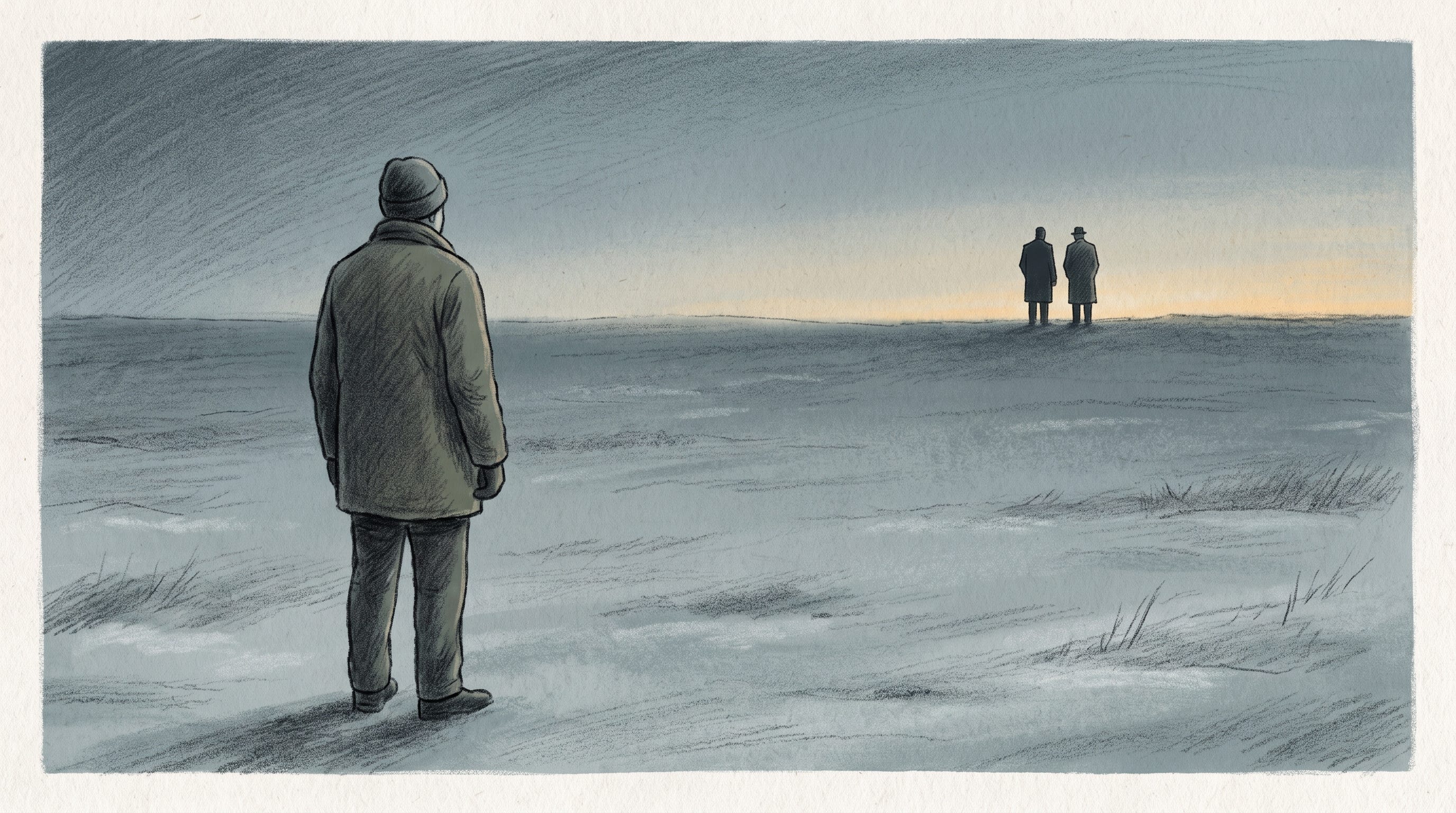
One of them I’d still recognize by the way he walks. The other could pass me in an airport and I might not know him.
I know their names. I know the history. I don’t know the men carrying either one.
The last time
I can tell you the last time I saw each of them, which isn’t the same as knowing them.
The younger one, a little over a year ago. Long enough to see that he’d become a young man. Long enough to believe, for a while, that we might still get to know each other. Then his behavior reached a point we could no longer explain away. We set boundaries and urged him to get trauma-informed help. He dismissed both, and the silence returned. I asked the people closest to him to take it seriously. From what I could see, they chose not to.
The older one I haven’t seen in years, and the last real memory I have of him is a parking lot. He was crossing from her car to mine. My wife, my younger son and my stepson were already inside the car. His mother got out, raised her middle finger at me and began shouting, “Fuck you.” Not once. Again and again. People leaving the coffee shop turned to look. The boys and adults closest to the scene could hear every word.
I said, once, that he was my son too.
Then I stopped. There was nothing to be gained by answering aggression with anything but silence, and too much to lose with the boys watching. So I looked away and let the scene exhaust itself.
That’s the picture left on top of the stack. Not a graduation. Not a goodbye. My son crossing the space between our cars while my place as his father was being treated like an intrusion. Learning, one more time, that moving toward me came with a punishment: his mother’s anger, loud and public, with him standing in the middle of it.
The grief nobody has a slot for
There’s a loss people know how to hold: a child who’s gone. They bring a casserole for that one, or at least go quiet and kind.
This is different, and harder to explain without making it sound like a riddle. My sons are alive. Somewhere, they’re moving through ordinary days, becoming more fully themselves. But I didn’t only lose the boys I knew. I lost the introduction to the men they became.
It’s grief without a body and without an ending. The people are still here, out in the world, and somehow no longer mine to know.
Whole persons assembled themselves during the years I was kept outside their lives. One graduated from West Point. The other graduated from Air Force basic training. I wasn’t there for either one. No invite. No seat. No photograph. No moment afterward where a father gets to look at his son and say, I saw what it took for you to get here.
And the grief keeps reaching forward. If they marry, I don’t know whether my wife and I will be in the room. If they have children, I don’t know whether I’ll hear the news from them, from someone else or not at all. There may be grandchildren whose faces I never learn, birthdays I don’t know to count and whole branches of my own family growing somewhere beyond my reach.
That’s the part people rarely understand. Estrangement doesn’t only take the relationship you had. It keeps taking the future as it arrives.
Estrangement doesn’t only take the relationship you had. It keeps taking the future as it arrives.
One of them learned what makes him laugh in rooms I wasn’t in. One of them figured out what he believes, what he can’t stand, whether he drinks his coffee like I do or nothing like me at all. I get pieces secondhand, if I get them at all.
I’m grieving two strangers I’d recognize instantly and not at all.
What I do with it, which isn’t much
I don’t have a practice for this. There’s no ritual that fits a loss that keeps changing shape while the people inside it are still alive. What I have are small habits that can’t fix anything, but keep the door from closing all the way.
I keep the same phone number I’ve had for years, the one they once knew by heart, in case a hand that used to be a small hand ever dials it. I read about the places they might be living. And when I see a man their age in a crowd, some old animal part of me checks his face before the rest of me can explain that it won’t be him. That this isn’t how it happens. That a son doesn’t usually return by appearing at the other end of a grocery aisle.
I’m not going to tell you I’ve made peace with it. Peace isn’t the word. What I’ve made is room. Room for the grief without letting it occupy every chair. Room for the possibility that nothing changes, and for the smaller possibility that one day something does.
I hold the boys because the boys are what I was actually given. And I leave the line open for the men they became, on the chance that one of them, some ordinary afternoon, decides he’s ready to let me meet him.
Author’s Note
This article is a work of personal nonfiction based on my own memory and experience. Names, ages and identifying details have been changed or withheld to protect the privacy of everyone involved, including my children.
I write from my perspective as a father, but estrangement isn’t gender-specific. If you’re a mother living through something like this, the weight of it belongs to you too.