

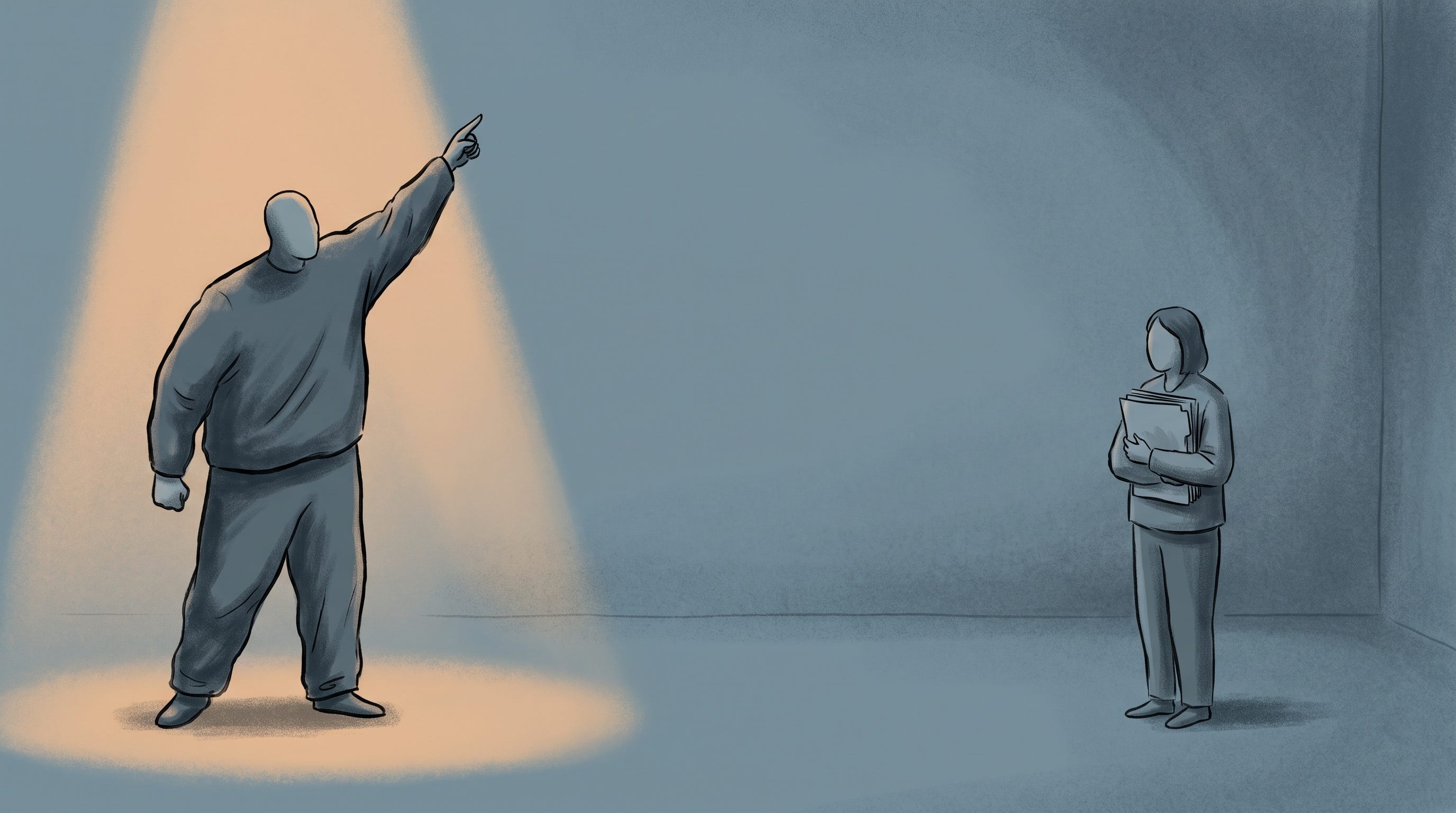
There’s a move that turns up wherever a person has to stay right about something they did. They deny it happened. They attack whoever pointed it out; the person and not the point. And then comes the part that does the real work: they trade places with you.
It has a name. Psychologist Jennifer Freyd called it DARVO, for Deny, Attack, Reverse Victim and Offender. Once you’ve watched it happen to you, you can’t stop seeing it. That turns out to matter more than I understood for a long time, and I’ll get to why.
I’ve been on the wrong end of the reversal for years. This is the part where it stopped being a feeling and became documentation of repeated behavior.
She went to court to be the victim
In 2018 my ex-wife filed for a civil harassment restraining order. Not against me. Against my wife.
She was asking a court to put it in writing that my wife was the danger and she was the one who needed protecting. It was dismissed inside of three weeks.
I want to be exact, because exactness is the whole reason to write a piece like this. My ex filed. The court dismissed it. Those aren’t my assumptions … they’re the docket. What she reached for was a page with a judge’s signature declaring my wife the aggressor and herself the protected party. What the record shows is that she didn’t get it.

I’m not going to relitigate the moment behind the filing here. In my view, from what I witnessed, it ran the other direction with regard to the aggressor, and that is a different piece. What I want to point at is the shape of the request itself. When you have to be the one who needs protection, the other person has to become the threat. The paperwork requires a villain, and in situations like this it’ll usually never be the person creating the paperwork.
It doesn’t stay in one building
The court wasn’t the only institution she brought the victim story to.
Back in 2012, there was an apparent burglary at her house. I was living in Santa Cruz then, about a hundred and eighty miles away, a three-hour drive each way. I found out because the police called me while I was in a meeting. The officer sounded almost apologetic. It felt like a call he didn’t believe in. He told me, half jokingly, that she had named me as a possible suspect and that he was calling as a matter of due diligence. The timing made it impossible. I could not have left the office, driven three hours to her house, committed the burglary, and driven three hours back within the window in which it happened. The officer seemed to understand that before he ever called.
From what I later learned, she had made the accusation in front of our boys. The accusation didn’t have to survive contact with the timeline. It only had to be said in front of our boys. The point, as far as I could tell, was not to persuade the police. It was to put the possibility into the boys’ heads that their father might be the kind of man who would do it.
Sit with the geography. A break-in, and the person they were nudged to blame was a father three hours away with no key and no reason to be there.
There was another detail I could never make sense of. Much of what the boys reportedly said was missing sounded like things I had given them over the years: gifts, personal belongings, pieces of their lives that had come from me. I was never able to verify exactly what was taken, or whether the descriptions I heard were complete and accurate. But if they were, the pattern was difficult to ignore. Of everything that might disappear from a home, why did so much of it appear to be connected to me?
I don’t know the answer. I only know that the question was never asked as loudly as my name was spoken.
It appeared to me, even then, that this was the point. If something goes missing, there’s already a name attached to it, and the name keeps a child’s eyes pointed in a useful direction.
I’ve written about the other rooms this reached. The time it arrived at my employer in an email calling my wife and me dangerous people. The version where the money story never matched the record. Each one has its own documents, its own setting, its own audience. Put them side by side and the room keeps changing while the move holds still. A courthouse. A police station. An HR inbox. Different doors, the same story waiting behind every one of them: she is the one being hurt, and I am the one doing the hurting. It only works as long as no one stops to compare the story with the record.
The room keeps changing while the move holds still.
It didn’t always take an institution. When the internet dropped at their house, the boys told me later, they were told their father was trying to hack the network. I work in cybersecurity, so the accusation wore a lab coat: the fact that I had professional knowledge of cybersecurity was offered as proof that I had hacked it. That is a non sequitur, capability standing in for evidence, but a non sequitur doesn’t have to be sound to land. It only has to be repeated to someone with no reason yet to question it. A bad internet connection turned into one more quiet sign that Dad was the danger in the walls.
Another time, the boys told me they had gone with their mother to Six Flags Discovery Kingdom in Vallejo. There was apparently a problem with the hotel reservation, and, according to what they later described, she became upset and blamed me for it in front of them. I had not known they were taking the trip. I had not been told where they were staying. I knew nothing about the reservation until the boys told me afterward that something had gone wrong and my name had somehow entered the room.
That detail matters. I wasn’t merely blamed for things I could not reasonably have done. I was blamed for problems I could not even have known existed. A hotel reservation I had never seen. A trip I did not know was happening. An internet connection in a house three hours away. The facts changed, but the explanation stayed available: when something went wrong, their father could be placed behind it.
Years later, my younger son told me about another instance. Law-enforcement officers had apparently gone to my ex’s stepfather’s house over a matter that had nothing to do with me. I was not there, I have never seen an incident report and I do not know precisely what the officers were investigating or which agency was involved.
What my son remembered was that his mother repeatedly tried to bring my name into the conversation in front of the boys. Even with officers standing in someone else’s home about someone else’s conduct, I could still be offered as the explanation. I cannot independently verify every detail of what he described. I can only be exact about how the story reached me: one of my sons told me that, once again, their mother was trying to point law enforcement toward their father.
The boys were being taught a way of interpreting the world. Not through one grand accusation, but through repetition. A missing object. A dropped connection. A reservation problem. Ordinary frustrations were given the same hidden cause until suspicion no longer needed evidence. It only needed my name.
Why it works on everyone but the record
Freyd and her colleague Sarah Harsey studied what the reversal does to the people watching. It works. In their experiments, observers exposed to DARVO believed the accused person more, believed the person reporting harm less and placed more blame on the person making the accusation.
The mechanism is not exclusive to abusive relationships. It resembles something researchers have documented in coercive groups and systems: control the account available to the audience, discredit the person who contradicts it and recruit the people around them to carry the approved version forward. The facts do not have to disappear. They only have to become socially harder to reach than the story.
That is why the first version people hear can matter so much, especially when they have no docket, timeline or set of documents in front of them. The reversal supplies an answer before anyone knows there is a question: she is the one being harmed, and I am the one doing the harming.
But Harsey found one more thing, and it is part of why I keep doing this in public even when it costs me. When people were taught what DARVO was before they encountered it, some of its effect weakened. Naming the move did not make anyone immune, but it interrupted the reflex to accept the reversal at face value. It created enough distance to question the story, look for the record and think more critically about who was actually being harmed.
“Science is much more than a body of knowledge. It is a way of thinking. Science invites us to let the facts in, even when they don’t conform to our preconceptions.”
— Carl Sagan
So I will keep setting the record next to the story where people can see both. Not to win something with her. To give someone else caught inside a story that doesn’t match the record a name for what is happening, a little earlier than I got one.
The audience was always the children
The observers the reversal recruits were never just judges and HR departments and patrol officers. The most important audience in the room was two boys. If the accepted story is that their father is something to be afraid of, then every bit of warmth I offered them can be re-read as a threat, and every time they were kept from me can be re-read as someone keeping them safe. A child can’t pull a court record. A child feels which parent acts frightened and lines up behind the fear, because that is exactly what children are built to do.
I have written before about one afternoon when I arrived to take the boys to the Magic Castle. My ex and her sister were waiting outside the house. What should have been an ordinary handoff became a confrontation, with the boys placed in the middle and made to tell me themselves that they would not go. I left without them.
A few weeks later, my ex took them to the Magic Castle herself.
That detail has stayed with me because it clarifies what the objection could not have been. The place was not unsafe. The experience was not inappropriate. The problem was not the Magic Castle. The problem was going there with their father.
That is how the reversal reaches a child. The parent offering the experience becomes the danger. The people obstructing it become the protectors. Then, once the father has been removed from the picture, the supposedly unacceptable experience becomes acceptable again.
And it was never one accusation. It was a habit. The burglar three hours away, the hacker in the walls, the hotel reservation issue, the dangerous man in the HR inbox: different rooms, and enough of it reached the boys that the shape set. The research describes the strategy plainly. “Creating the impression that the targeted parent is dangerous” is one of the documented alienation strategies Amy Baker catalogued, and the team led by Jennifer Harman argues that directing that strategy at a child is not ordinary custody friction but a form of family violence in its own right. An accusation made where a kid can hear it does not have to be true to work. It only has to be repeated until fear becomes the floor the child stands on.
Sometimes I think she believed her own story. Sometimes I think she only needed it for leverage. I’ve stopped needing to know which, because the result was the same: two boys who learned that reaching for their father set off an alarm, and that safety meant moving closer to the person who kept pulling it. The same open line and the same closed door from the last piece, only this time the reversal was aimed at the audience instead of at me.
Reaching for their father set off an alarm. Safety meant moving closer to the person who kept pulling it.
Those boys are grown men now, and that is the part I can’t make soft. The fear was installed before either of them was old enough to refuse it, and it did not expire at eighteen. Amy Baker’s research on adults who were alienated as children is plain about what can remain: the effects often outlast childhood, and so does the distance. They are men who could pull the record today and read it for themselves. They have not. Becoming old enough to see the evidence did not automatically make them free enough to look at it. Whatever name you give her intent, the shape it left in them is the shape of control, and it is still holding.
What the record was protecting
So here it is, set down next to the story one more time. A restraining order she filed and a court dismissed. A burglary I could not have committed from three hours away. An employer told I was dangerous because of a court outcome that never happened.
In every version, she is the victim and I am the threat. In every version, the record refuses to cooperate. After enough years, I stopped being surprised by the accusations. They had begun to look like projection.
Projection: when the accusation describes the person making it more clearly than the person it lands on.
I do not get to make anyone read this. Not the courts that moved on. Not the two young men who were once boys reaching for their father. I only get to keep it, keep it accurate and leave it somewhere it can be found.
The record cannot make anyone question the story they were given. It can only remain there until they are ready to let the facts in.
Look at what is present, but also at what had to be left out for the story to hold.
Observe which questions were answered with evidence and which were answered only with repetition.
Only trust a conclusion after applying the same standard to everyone involved, including me.
Know the difference between what you witnessed, what the record shows and what someone taught you to believe.
Ask what you know firsthand.
Give repetition no more weight than evidence.
Avoid replacing one person’s authority with another’s.
Investigate without deciding in advance what you are supposed to find.
Nothing here requires agreement. Only a willingness to look.
Resources
The research referenced above, for anyone who wants the primary sources.
DARVO (Deny, Attack, Reverse Victim and Offender): Jennifer J. Freyd, PhD, definition and overview. jjfreyd.com/darvo
What DARVO does to observers: Harsey, S.J. & Freyd, J.J. (2020). “Deny, Attack, and Reverse Victim and Offender (DARVO): What Is the Influence on Perceived Perpetrator and Victim Credibility?” Journal of Aggression, Maltreatment & Trauma, 29(8). doi:10.1080/10926771.2020.1774695
“Creating the impression that the targeted parent is dangerous” (one of the 17 documented alienation strategies): Baker, A.J.L. & Fine, P. (2008). Beyond the High Road: Responding to 17 Parental Alienation Strategies Without Compromising Your Morals or Harming Your Child.
Alienating behaviors as a form of family violence: Harman, J.J., Kruk, E. & Hines, D.A. (2018). “Parental Alienating Behaviors: An Unacknowledged Form of Family Violence.” Psychological Bulletin, 144(12), 1275-1299.
The effects into adulthood: Baker, A.J.L. (2007). Adult Children of Parental Alienation Syndrome: Breaking the Ties That Bind. W.W. Norton.
Author’s Note
This article is a work of personal nonfiction based on my own memory, correspondence, court records and other documentation. It reflects my individual perspective and experience, and is not intended as legal or psychological advice. Names, dates and identifying details have been changed or withheld to protect the privacy of everyone involved, including my children.
A note on gender: I write from my perspective as a father, but the patterns of coercive control and estrangement are not gender-specific. If you are a mother living through something like this, the weight of it belongs to you too.
Great post. This was all so hard and frustrating. To have these boys believe her is beyond me. Its laughable at this point the reach she has attempted that never amounts to anything. It’s the ex that cried wolf except she keeps being allowed to……one day the proverbial wolf will catch up to her.